
Introduction to Punjab’s Digital Land Revolution (2026 Edition)
The landscape of property management in Punjab has undergone a radical transformation. Through the state government’s ‘Easy Registration’ initiative, the historically cumbersome and opaque ‘Patwari culture’—often synonymous with long queues and intermediaries—has been effectively dismantled. As a Senior Property Consultant, I have witnessed the shift from manual ledgers to a sophisticated digital ecosystem managed by the Punjab Land Records Society (PLRS).
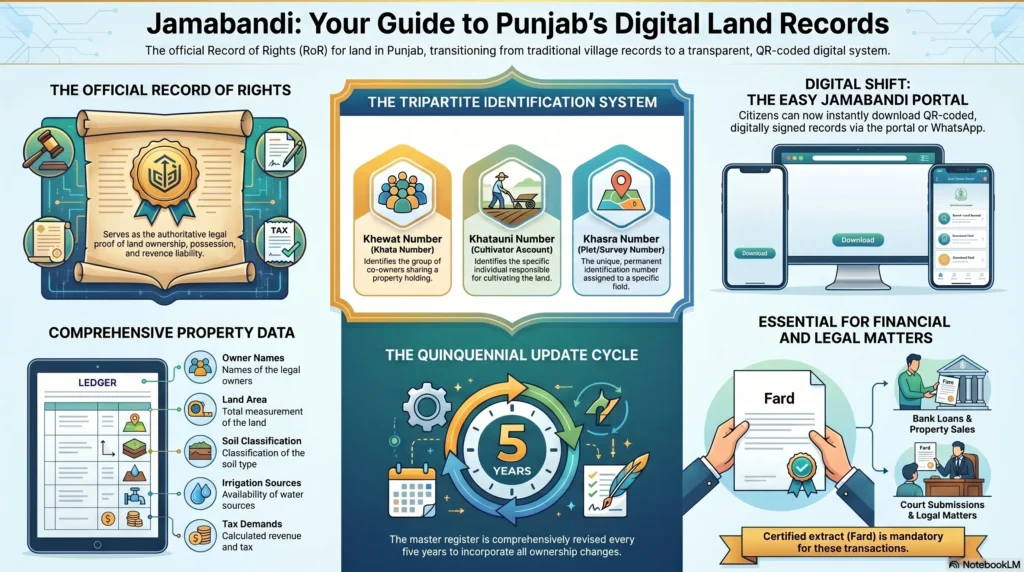
Today, 99% of land records across the state are digitized. The system has moved away from the need for physical presence and informal payments toward a transparent, digitally-led model. Citizens can now access verifiable, digitally signed records from anywhere in the world, ensuring that the primary “Record of Rights” is just a few clicks away.
Key Terms and Definitions in Punjab Land Records
To perform proper due diligence, one must understand the technical vernacular of the Punjab Revenue Department. As a legal technology specialist, I advise all clients to familiarize themselves with these terms:
- Jamabandi: The central document of the land record system, acting as the ‘Record of Rights.’ Modern digital versions include QR codes for instant verification.
- Intkal (Mutation): The process of recording a change in ownership. In the current system, mutations are often automated following a deed registration.
- Rapat: An entry of land-related reports or notifications within the revenue registry.
- Fard Badar: The specific process for the correction of clerical errors (such as name misspellings) in the record.
- Consultant’s Note: Unlike record viewing, filing for a Fard Badar requires a nominal application fee, payable via the online portal.
- Khewat Number: A specific identifier representing the owner’s total holding or account. This often covers a group of owners.
- Khasra Number: The specific survey or plot number assigned to a particular piece of land.
The ‘Easy Jamabandi’ Portal: Core Services
The jamabandi.punjab.gov.in portal, managed by PLRS, serves as the primary gateway for “Easy Jamabandi” services. The following digital features are essential for modern property monitoring:
- WhatsApp te Jamabandi: Users can receive their records directly on their mobile devices.
- Online Intkal Seva: A seamless mutation service for heirs and buyers.
- Jamabandi layi Subscribe karo: An automated monitoring service (essentially a “Digital Watchdog”) for land titles.
- Digital Signatures & QR Codes: Every downloaded record is now a valid legal document under the IT Act. The integrated QR code allows any third party—such as a bank or legal firm—to verify the document’s authenticity instantly.
Expert Corner: While digitally signed copies are legally verifiable, I always remind clients that for certain high-value transactions, some financial institutions may still request a physical “attested” copy. Always check your specific bank’s requirements during the loan process.
Step-by-Step Guide: How to Check Property Ownership Online
To access records via the official portal, follow this professional workflow:
- Navigate to jamabandi.punjab.gov.in (or
revenue.punjab.gov.in). - Click on the ‘View Property Record (Jamabandi)’ tab.
- Select the District, Tehsil, and Village from the dropdown menus.
- Choose your search criteria. You may search by Owner Name, Khasra Number, or Khewat Number.
- Consultant’s Warning: In Punjab, searching by “Owner Name” can be problematic due to common names (e.g., “Gurpreet Singh”). For maximum accuracy and to avoid identifying the wrong property, I recommend searching by Khasra or Khewat numbers.
- Enter the required details and fetch the record.
- Download the free, digitally signed copy for your files.
Understanding Mutation and Correction Timelines
The government has introduced strict statutory windows to ensure accountability. A key feature of this transparency is the automated WhatsApp update system, which triggers alerts at every stage—provided you enter an active mobile number during the initial online application.
| Service Type | Statutory Time Limit | Fee Structure |
| Automatic Mutation (After Sale Deed) | 30 Days | Included in Registration |
| Inheritance Mutation Request | 30 Days | Free |
| Correction of Errors (Fard Badar) | 15 Days | Nominal Online Fee |
Pro-Tip: If you have already registered a sale deed at the Sub-Registrar’s office, the mutation is now automatic. You do not need to file a separate request; the system will update the record within the 30-day window.
Protecting Ownership: The Subscription Service for NRIs
The ‘Jamabandi layi Subscribe karo’ service is perhaps the most significant tool for Non-Resident Indians (NRIs). Historically, the “Patwari culture” allowed for records to be surreptitiously altered, often leading to decades of litigation that NRIs were ill-equipped to manage from abroad.
By subscribing, you effectively place a “Digital Watchdog” over your title. Any attempt to modify the record or initiate a mutation triggers an immediate alert. This proactive protection prevents unauthorized transfers before they can lead to long-delayed legal struggles in court.
Conclusion: The Benefits of a Transparent System
The digitisation of Punjab’s land records provides a blueprint for transparent governance. By removing the need for physical queues and bribes, and offering free, high-speed access to information, the state has empowered property owners.
As a legal technology specialist, my final advice is simple: Regularly verify your records. Ownership is no longer just about a physical deed in a safe; it is about the accuracy of the digital entry in the PLRS database. The QR-coded, digitally signed document you download is a robust, verifiable legal record—use it to secure your assets and ensure your peace of mind.
Frequently Asked Questions (FAQs)
What is Jamabandi in Punjab?
The Jamabandi is the official “Record of Rights” prepared for every village. It is updated every five years and serves as legal proof of land ownership, possession, and revenue liability.