Introduction: The Digital Revolution of UP Land Records
The administration of land in Uttar Pradesh has historically been a labyrinthine process, defined by the “Lekhpal” system. For generations, the Lekhpal (local revenue officer) was the sole custodian of manual registers, known as Bahi-Khatas. Landowners were often at the mercy of physical record-keeping, requiring arduous visits to Tehsil offices and navigating a bureaucracy that was prone to delays and human error. However, as we progress through 2025, this legacy system has been transformed by a comprehensive digital ecosystem.
The transition from manual registers to the current digitised framework represents a pinnacle of Indian digital governance. The term “Bhulekh” is an elegant portmanteau of two Hindi words: ‘Bhu’ (meaning land) and ‘Lekh’ (meaning account or record). Consequently, Bhulekh UP serves as the state’s official “Account of Land.”
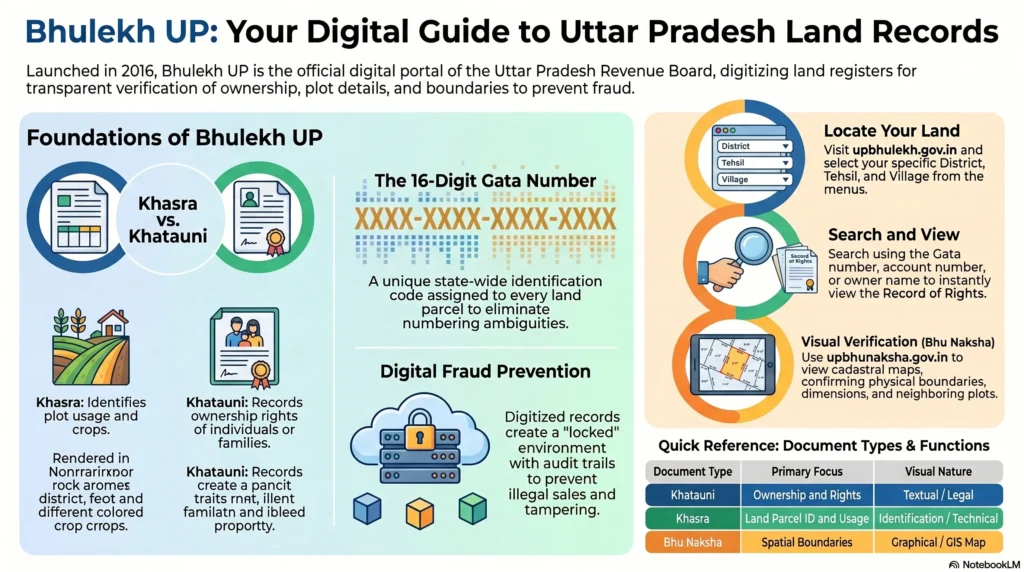
Managed by the Uttar Pradesh Revenue Board in collaboration with the National Informatics Centre (NIC), the portal (upbhulekh.gov.in) has digitised over 2 crore land parcels. This digital revolution eliminates the need for physical visits for preliminary verification, providing a transparent, tamper-proof, and easily accessible database for farmers, property investors, and the NRI community. By centralising records, the government has created a digital bridge that ensures “title clarity”—a fundamental requirement for modern real estate transactions and agricultural credit.
What is Bhulekh UP? Understanding the 2025 Digital Database
Bhulekh UP is not merely a website; it is a sophisticated Record of Rights (RoR) management system. It operates under the mandate of the Digital India Land Records Modernisation Programme (DILRMP), which seeks to unify spatial (maps) and textual (ownership) data.
Scope and Technical Authority
The portal encompasses all 75 districts and 351 tehsils within Uttar Pradesh. As a technology consultant, it is vital to note that this database is built on a robust RDBMS (Relational Database Management System) that allows for real-time updates during the mutation cycle. This ensures that when a property is sold or inherited, the change is reflected digitally once verified by the revenue chain.
Key Information Available
The portal provides a multi-layered view of a property’s health:
- Owner Identification: Precise names of current and previous shareholders.
- Transaction History: A chronological Record of Rights (RoR) tracking every legal transfer.
- Plot Dimensions: Area measurements traditionally recorded in hectares or square metres.
- Encumbrances: Critical data on whether the land is pledged as collateral (mortgaged) with a bank.
- Legal Standing: Visibility into whether the specific Gata number is currently flagged for a dispute in the Revenue Court.
Essential Terminology for 2025
To navigate the system like an expert, one must master the following revenue vocabulary:
- Khasra Number: A unique survey number assigned to a specific plot. Think of it as the “Address” of the soil itself.
- Khatauni: The register of persons cultivating or occupying the land. It is the definitive document for proving ownership.
- Gata Number: A unique 16-digit identification code assigned to each land parcel. This code is the backbone of the digital database, ensuring no two plots are confused.
- Khewat: An identifier assigned to a co-owner. In a state where family-owned land is common, the Khewat number helps distinguish individual shares.
- Mutation (Virasat/Virasat): The process of transferring a title from one person to another in the official records.
- Sajra: The village map that shows all the Khasra boundaries in a spatial format.
What’s New in 2025? Agri-Reforms & Tech Upgrades
The 2025 iteration of Bhulekh UP is the most advanced to date, driven by the 2025 Agri Reforms Bill. This legislation has mandated that land records are no longer static “archives” but active “financial assets.”
Technical Specifications & Digitisation Quality
The Board of Revenue has implemented rigorous standards for the current database. As per the latest technical specifications (Source 10), all original village maps (traditionally at 1:4000 or 1:3960 scale) have undergone high-resolution scanning.
- Scanning Resolution: Maps are scanned at 300 DPI (dots per inch) to ensure that even damaged or historical sheets are captured with legibility.
- Vectorisation: These scans are not just images; they are converted into vector data using GIS software, allowing for “Mosaicing”—the process of joining individual village sheets into a seamless, state-wide digital map.
- Positional Accuracy: The system now corrects for “skewed or warped” historical maps, ensuring the digital layout matches the physical ground reality with a margin of error within +/- 0.1%.
The Impact of 2025 Agri Reforms
The synergy between land records and financial tech is at an all-time high:
- PM-Kisan & e-KYC Integration: Land records are now automatically cross-referenced with Aadhaar-linked PM-Kisan data. This “automated benefit transfer” prevents subsidy leakages.
- SVAMITVA Scheme: The 2025 landscape benefits from drone-based mapping. Drones provide a high-precision alternative to the old 1:4000 sheets, especially for rural Abadi (residential) areas where records were previously non-existent.
- Credit Eligibility: The “Real-time Khatauni” is now accepted as a “Digital Credit Passport” by most public and private sector banks in UP.
Bhulekh UP Performance Growth (2023–2025)
| Metric | 2023 | 2024 | 2025 (Projected) |
| Registered Users | 1.8 Crore | 2.1 Crore | 2.6 Crore |
| Online Downloads | 8 Crore | 10.2 Crore | 12.5 Crore |
| Village Digitisation | 97% | 99% | 100% |
Step-by-Step: How to Check Khasra & Khatauni Online
The 2025 UI of upbhulekh.gov.in has been optimised for speed. Here is the professional workflow for retrieving your records.
Checking Real-Time Khatauni
- Access the Portal: Navigate to the official URL. Beware of third-party “scam” sites; always look for the
.gov.inextension. - Select the Primary Service: On the homepage, locate the button labelled “View Copy of Real-time Khatauni” (or Khatoni Ki Nakal Dekhein).
- The Authentication Gate: You will encounter a Captcha. This is a security measure to prevent automated “scraping” of the state’s sensitive data.
- District & Tehsil Selection: Choose your District, then your Tehsil, and finally your Village.
- Data Input: You have four search options:
- By Khasra/Gata Number.
- By Khata Number.
- By Owner’s Name (Khatedar ka naam).
- By Date of Mutation.
- Viewing the Record: Once you enter the details, click “uddharan dekhein” (view account details). The digitised record will appear in a new window. It is highly recommended to save this as a PDF for your personal archive.
Searching by Different Methods
Searching by the Owner’s name is the most common method, but it requires the exact Hindi spelling. If the system returns “Record Not Found,” it is likely a spelling mismatch. In such cases, searching by the 16-digit Gata Number is the “gold standard” as it bypasses linguistic variations. Searching by Khata Number is best for large families who want to see all parcels grouped under a single ledger.
Bhu Naksha UP: Navigating Visual Plot Maps
While Bhulekh tells you who owns the land, Bhu Naksha UP (upbhunaksha.gov.in) tells you where it is. This is a GIS-based (Geographic Information System) platform that is essential for boundary verification.
Technical GIS Layers
The 2025 Bhu Naksha interface allows users to toggle specific layers that were once only available to revenue officials. Understanding these codes is essential for due diligence:
- Poly_Khasra: The primary boundary layer for individual plots.
- Poly_Chak Road: Identifies rural pathways and roads that must remain unblocked.
- Poly_Bandh: Shows embankments or water-control structures.
- Poly_Nala & Poly_River: Critical for identifying flood zones or riparian rights.
- Poly_Village Boundary: The macro-limit of the entire revenue village.
The “Mosaicing” Advantage
In the past, village maps were separate sheets. If a plot sat on the edge of two sheets, it was difficult to verify. The 2025 system uses Village-level Mosaicing, joining all individual sheets into a single digital fabric. This allows for seamless “Edge Matching,” ensuring that boundaries are logical and do not overlap with adjacent villages.
Competitive Landscape: Bhulekh UP vs. Other Portals
As an SEO content architect, I monitor these systems nationwide. Bhulekh UP currently leads the “Hindi Belt” in terms of feature depth and integration.
Competitor Comparison Table
| Feature | Bhulekh UP (UP) | Dharani (Telangana) | Mahabhumi (Maharashtra) |
| Khasra Access | Free & Real-time | Free | Free |
| GIS Mapping | Full (Bhu Naksha) | Partial | Partial |
| PM-Kisan Integration | Automated | Manual | Partial |
| 2025 Reform Alignment | Complete | Ongoing | Ongoing |
| Loan Linkage | Bank Bandhak Dashboard | Integrated | Integrated |
Advanced Portal Features: Beyond Basic Ownership
The 2025 portal has evolved into a full-scale due diligence platform. Property buyers and legal professionals should utilise these specific dashboards:
Bank Bandhak Dashboard: Financial Due Diligence
In UP, agricultural land is often pledged for “Kisan Credit Cards” (KCC). The Bank Bandhak Dashboard allows you to see if a specific Gata is currently “pledged” (encumbered). Purchasing pledged land without a “No Objection Certificate” (NOC) from the bank is a major legal risk.
Enemy Property (Shatru Sampatti)
These are properties left behind by individuals who took citizenship in countries like Pakistan or China during historical conflicts. These lands are managed by the Custodian of Enemy Property for India. The Bhulekh portal lists these Gata numbers clearly; they are legally “unsaleable.”
Vacated Property (Nishkrant Sampatti)
Similar to enemy property, these were vacated during the 1947 partition. These land parcels are currently governed by the state and are ineligible for private sale.
Disputed Property Status
The portal now includes a “Gata dispute status” tool. By entering a Gata number, the system queries the Revenue Court Management System (RCMS). If there is an active case (e.g., a partition suit or boundary dispute), the system will flag the record, warning potential buyers of the “Lis Pendens” (pending litigation).
Troubleshooting & Common Mistakes
Even with advanced tech, user error is the primary cause of failed searches.
Top 5 Mistakes to Avoid
| Mistake | Consequence | How to Avoid |
| Using old 2023 village codes | “Village Not Found” | Use the “Know Village Code” tool for 2025 updates. |
| Confusing Khasra with Khatauni | Incorrect valuation | Khasra = Plot Map/ID; Khatauni = Title/Ownership. |
| Ignoring “Real-time” portal | Viewing stale data | Always select “Real-time Khatauni” for latest mutations. |
| Hindi Spelling errors | “No record found” | Use the Gata number search to bypass spelling. |
| Neglecting map overlay | Boundary encroachment | Cross-verify Bhu Naksha before any fencing or construction. |
Technical Solutions
- Data Mismatch: If the digital map area does not match the textual Khatauni area, you must file for a “Re-validation” through the portal.
- Loading Errors: The 2025 portal is high-traffic. If the site fails, clear your browser cache (Ctrl+F5) or use the official mobile application, which uses a lighter data payload.
Legal Validity & Complaint Redressal
It is a common misconception that an online printout is a “Legal Title.” As a technology consultant, I must clarify the legal nuances.
Digital Copy vs. Certified Copy
The record you see on upbhulekh.gov.in is for informational purposes only.
- Online Copy: Valid for checking your own status, applying for a preliminary loan query, or due diligence.
- Certified Copy: To present evidence in a court of law or to finalise a bank mortgage, you must obtain a “Certified Copy.” This is a physical document stamped and signed by the Tehsildar or Lekhpal at the Tehsil office.
Jansunwai UP: Filing Grievances
If you discover an error (e.g., a misspelt name or an incorrect area), do not ignore it. The portal is integrated with Jansunwai UP. You can file a “Mutation Error” or “Record Correction” request online. This triggers a workflow to the local Lekhpal, who must verify and correct the digital record within a stipulated timeframe.
Official Contact Details
Board of Revenue, Lucknow (Computer Cell)
- Address: 2nd Floor, West Block, Janpath, Lucknow – 226001
- Phone: 0522-2630667 / 0522-2217145
- Email: bhulekh-up@gov.in / upbhulekh@gmail.com
Conclusion & Takeaways
The digitisation of UP land records through the Bhulekh and Bhu Naksha portals has dismantled the information asymmetry that once plagued the state. By 2025, the system has matured into a GIS-integrated, reform-aligned powerhouse that empowers every landowner. However, digitisation is only effective when coupled with citizen vigilance.
Key Takeaways
- Audit Your Land: Check your Real-time Khatauni every six months to ensure no fraudulent mutations have occurred.
- Technical Due Diligence: Use the 300 DPI maps on Bhu Naksha to verify that your physical fences align with the digital “Poly_Khasra” layer.
- Certified for Legal: Always bridge the digital gap by securing a certified copy for any high-stakes financial transaction.
- Agri-Ready: Keep your land record and Aadhaar data synchronised to ensure uninterrupted access to PM-Kisan and crop insurance benefits.
Frequently Asked Questions
1. Is Bhulekh UP free to use in 2025?
Yes, the Uttar Pradesh government provides free access to view and download land records for informational purposes. However, if you require a certified copy with a government seal, a nominal fee is payable at the Tehsil office.
2. Can NRIs verify their property from abroad?
Absolutely. The portal is accessible globally. NRIs can use the “Owner Name” or “Gata Number” search to monitor their ancestral properties without needing a local representative.
3. What is the difference between a Gata Number and a Khasra Number?
In common parlance, they are often used interchangeably. However, the Gata Number is the modern 16-digit unique identifier used by the digital database, while the Khasra Number is the traditional plot survey number found in the manual registers.
4. How do I find my Village Code?
The portal features a “Know the special code of revenue village” tool. Simply select your district and tehsil to generate a list of 6-digit village codes based on the 2011 Census and 2025 revenue updates.
5. What should I do if my mutation is not showing online?
Mutation updates usually take 15 to 45 days after the sale deed is registered. If it is not showing after this period, check the “Mutation Status” on the portal. If it is “Pending,” you may need to provide additional documentation to your local Lekhpal.
6. Can I use the Bhulekh mobile app?
Yes, there is an official mobile application. However, as a security precaution, avoid third-party apps that ask for your banking details or charge a fee for “searching.” Stick to the official government-linked apps found on the portal’s homepage.