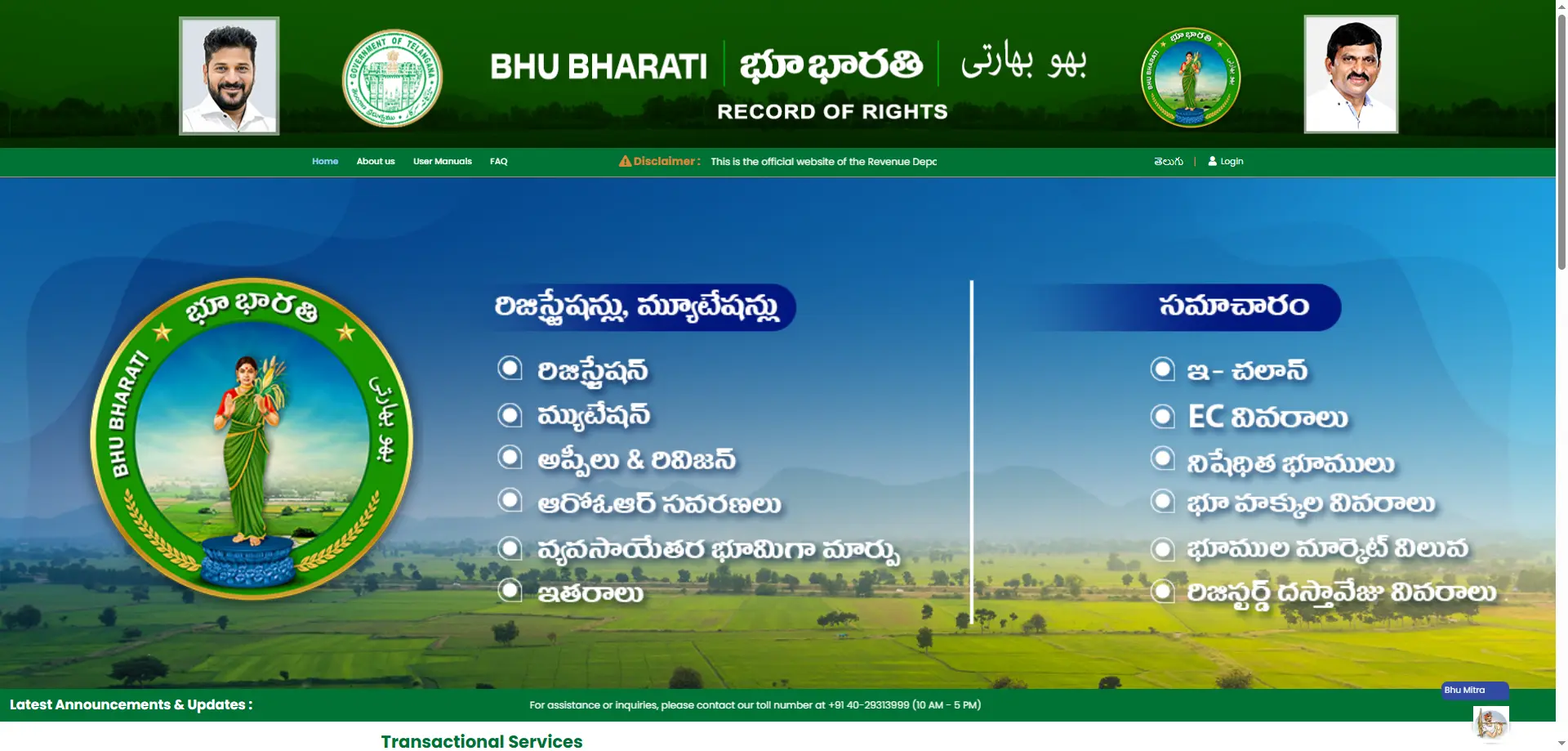
Introduction: From Dharani to Bhu Bharathi
The strategic transformation of Telangana’s land administration reached a critical milestone with the introduction of the Bhu Bharathi portal. This shift represents a definitive move away from the centralized Dharani system, which by December 2023 had accumulated a backlog of over 6.46 lakh pending grievances due to its rigid architecture and lack of correction modules. To fulfill the state’s objective of a “dispute-free revenue policy,” the government launched the Integrated Land Records Management System (ILRMS).

Officially operational as of April 2025, the Telangana Bhu Bharathi Act, 2025 provides the statutory framework for this overhaul. Unlike previous presumptive records, the new system is designed to provide conclusive land titling. By leveraging state-of-the-art geospatial technology, the government aims to guarantee ownership, effectively reducing long-standing litigation and establishing land as a secure, collateralizable asset for farmers and investors.
The Legislative Backbone: Telangana Bhu Bharathi Act, 2025
The Bhu Bharathi Act, 2025 (Act No. 1 of 2025) replaces the ROR Act of 2020, focusing on administrative decentralization and record accuracy. It provides the legal mandate to rectify historical errors that previously locked millions of acres in “Part B” (disputed) categories.
Key legislative improvements include:
- Restoration of the 11-Column Pahani: The Act restores the multi-column format, most notably reintroducing the “Enjoyment Column” (possession). This is vital for actual cultivators to access agricultural subsidies and crop insurance, even while titles are being regularized.
- Decentralization of Power: Authority has been returned to Tahsildars/MROs and Revenue Divisional Officers (RDOs). Local officials are now empowered to resolve record corrections at the mandal level, eliminating the need for citizens to travel to district headquarters.
- Regularization of Informal Transactions (Section 6-1): The Act provides a pathway to formalize “Sadabainama” (informal sale agreements) executed before June 2, 2014. This applies specifically to small and marginal farmers who have maintained possession for over 12 years.
Every registered landowner is issued a Pattadar Passbook (PPB), which is now digitally integrated with the central ILRMS database to ensure a single source of truth.
Technical Innovation: Bhudhaar and Drone-Based Surveys
Bhudhaar: The Aadhaar for Land (ULPIN)
Bhudhaar is a revolutionary 14-digit Unique Land Parcel Identification Number (ULPIN) assigned to every land parcel in the state. Much like a citizen’s Aadhaar, this number provides a permanent digital identity to the land.
Expert Insight: It is critical to distinguish between “Temporary” and “Permanent” Bhudhaar. A Permanent Bhudhaar is only assigned after the completion of geo-referencing for the parcel. These digital land cards are issued free of cost by the government; owners should be wary of agents demanding fees for this service.
Benefits of Bhudhaar:
- GPS-Mapped Boundaries: Every parcel is georeferenced, providing centimeter-level precision that prevents encroachment.
- Fraud Prevention: The ULPIN makes it impossible to register fake or duplicate documents against the same coordinate.
- Institutional Credit Access: Banks can verify ownership via the portal instantly, reducing loan processing from weeks to days.
- Permanent Identification: The ID remains constant even if survey numbers change due to future sub-divisions.
- Secure Transfers: Integration with Aadhaar-based e-KYC ensures that only the rightful owner can initiate a transfer.
Modern Surveying Technology
The accuracy of Bhu Bharathi is underpinned by drone-based photogrammetry and DGPS (Differential Global Positioning System) rovers. Drones map village boundaries while DGPS rovers establish Ground Control Points (GCPs). This data is used to generate Land Parcel Maps (LPMs), which are now mandatory attachments for every registration to visually confirm boundaries and prevent overlapping claims. For immediate assistance, the portal also features “Bhu Mitra,” an AI-powered chatbot designed to guide users through technical queries.
Getting Started: How to Login and Register on Bhu Bharathi
Accessing services is streamlined through the official portal at bhubharati.telangana.gov.in.
Step-by-Step Technical Guide:
- Navigate to the Portal: Visit
bhubharati.telangana.gov.in. - Role Selection: Choose your role (Citizen, NRI, Bank, or Organisation).
- Sign-Up: Provide your name, mobile number, and email ID.
- Verification: Complete the process using the OTP. For sensitive transactions, the system utilizes e-KYC via Aadhaar or MeeSeva to maintain high-security standards.
Expert Tip: Use a single, dedicated mobile number for all land-related transactions. This centralizes your property dashboard and prevents the “OTP lag” often associated with mismatched contact data in revenue records.
Core Information Services: ROR and EC Downloads
The portal provides immediate access to high-value land documents required for due diligence.
Land Details Search (ROR)
Users can search the Record of Rights by Survey Number or Pattadar Passbook Number. This service provides a comprehensive view of land classification (Wet/Dry), total extent, and ownership history. It is the primary tool for verifying a seller’s claims before signing a sale agreement.
Encumbrance Certificate (EC) Downloads
An EC is essential for property buyers to identify registered transactions, mortgages, or legal liabilities. On Bhu Bharathi, a 30-year EC can be generated in under two minutes.
- Government Fee: Typically ₹50 per year of search, or a standardized range of ₹100 to ₹300 for common search periods.
- Expert Advice: A 30-year search is the industry standard for establishing a “clear and marketable title” for bank loans.
Navigating Transactional Modules: Mutation, Succession, and NALA
The system simplifies high-stakes transactions into manageable digital workflows.
Application for Succession
This module facilitates the transfer of title to legal heirs. Applicants must upload a death certificate and a legal heir certificate or family tree affidavit. The system is designed to notify all family members to prevent future partition disputes.
Mutation Services
Mutation—the formal update of revenue records following a sale—has been expedited. Once a sale deed is registered, the mutation process is typically completed within a 7-15 day window after field verification by the MRO.
NALA (Non-Agricultural Land Assessment)
This service manages the conversion of agricultural land for residential or commercial use. Notably, the “NALA without PPB” workflow was introduced to facilitate urban development for buyers who hold registered sale deeds but lack the traditional agricultural passbook, reflecting the realities of rapid urban expansion.
Required Documents for Transactions
| Service | Primary Required Documents |
| Succession | Death Certificate, Legal Heir Certificate/Affidavit, IDs of all heirs. |
| Mutation | Registered Sale Deed, Identity Proof (Aadhaar), Previous Passbook. |
| NALA | Title Deed/Sale Deed, Site Plan (Sketch), Identity Proof, Payment Receipt. |
| RoR Correction | Proof of correct data (old deed/measurement slip), PPB copy. |
Comparative Analysis: Bhu Bharathi vs. Dharani
The transition to Bhu Bharathi reflects a fundamental shift from outsourced technical snapshots to a government-managed, comprehensive land registry.
| Variable | Dharani (Old System) | Bhu Bharathi (New System) |
| Technical Development | Outsourced to TerraCIS Technologies Ltd. | Developed in-house by NIC |
| Ownership Support | Focused on Single Ownership | Fully supports Joint Ownership |
| Dispute Resolution | Centralized (District Collector) | Decentralized (MRO/Tahsildar-led) |
| Record Depth | Minimal Digital Snapshots | Restored 11-Column Detailed Pahani |
| Mapping Type | Manual/Paper-based | Drone-based GIS / Digital LPMs |
| Refund Processing | Manual and often delayed | Automatic for cancelled slots |
| User Support | Limited Helpdesk | Bhu Mitra AI Chatbot |
Regional Implementation: Pilot Mandals and Rollout Schedule
Bhu Bharathi utilized a phased rollout to address the complex “RSR Mismatch”—a common issue where current physical possession does not match century-old Resettlement Survey Records.
The initial pilot was conducted in five mandals:
- Kosgi (Narayanpet)
- Amangal (Rangareddy)
- Vatpally (Sangareddy)
- Kusumanchi (Khammam)
- Aswaraopeta (Bhadradri Kothagudem)
During this phase, Revenue Sadassus (public hearings) were instrumental. MROs visited villages to resolve disputes on-site, a practice that has significantly reduced the grievance backlog by validating digital entries against ground reality.
Common Pitfalls and Troubleshooting
- OTP/Server Latency: If an OTP is not received, wait 2-5 minutes rather than requesting multiple resends. High traffic during “Revenue Sadassus” periods can cause delays.
- Payment Discrepancies: If a payment is successful but the status is “Pending,” wait 24-48 hours for the system to synchronize before filing a new application.
- Section 22-A (Prohibited Properties): If land is erroneously listed as prohibited under Section 22-A (e.g., wrongly marked as government land), use the “Grievance” module to upload title deeds. MROs are mandated to conduct on-site verification within 15 days.
Conclusion and FAQs
The Bhu Bharathi system is the foundation of Telangana’s “Vision 2030,” aiming for a 100% tamper-proof registry. By integrating high-precision mapping with a robust legal framework, the state is finally providing the transparency required for a modern economy.
Frequently Asked Questions
What is ePPB?
The Electronic Pattadar Passbook (ePPB) is a digitally signed version of your ownership record, available for instant download and legally valid for all transactions.
Is the portal available for NRIs?
Yes. Bhu Bharathi features a specialized NRI role with e-KYC flows designed for international mobile numbers and email-linked Aadhaar verification.
How does Joint Ownership work?
Unlike the previous system, Bhu Bharathi allows multiple owners to be recorded on a single land parcel, with each owner’s share percentage clearly defined in the digital RoR.
Can I edit a registration slot after payment?
Yes, the portal allows you to modify registration details and reschedule your appointment at the Sub-Registrar’s office up until the scheduled date.
What is the fee for an EC?
The government fee is ₹50 per year of the search period. For a standard comprehensive search, costs typically range between ₹100 and ₹300.
To ensure your property rights are fully protected, every landowner is encouraged to log in to bhubharati.telangana.gov.in today to verify their land records and check their Bhudhaar ULPIN status.