
The digital transformation of Andhra Pradesh’s land administration reached a critical milestone in 2025. Through the Meebhoomi portal, the state has integrated the objectives of the Digital India Land Records Modernization Programme (DILRMP) to provide landowners, buyers, and legal professionals with an Integrated Land Information Management System. This system ensures transparency, reduces the scope for fraudulent transactions, and streamlines the “Record of Rights” (ROR) for millions of citizens.
A significant fiscal update occurred on February 1, 2025, with the implementation of revised market value rates. This revision affected the entire state: market values were reduced in 158 villages where rates were disproportionately high, remained unchanged in 68 villages, and were increased in the remaining areas to align with current economic trends.
Understanding Key Terminology: Adangal vs. ROR 1-B
In the Andhra Pradesh revenue ecosystem, distinguishing between an Adangal and a 1-B extract is essential for any property transaction or legal verification.
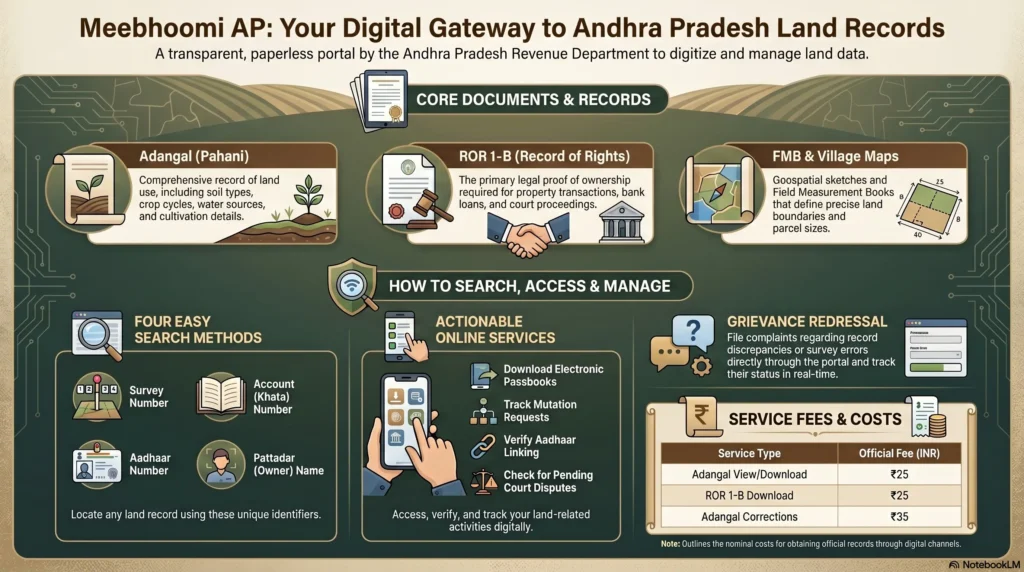
- Adangal (Pahani): Known as “Village Count Number 3,” this is a detailed account of land usage. It is updated periodically through Azmoish (field inspection) by the Village Revenue Officer (VRO) to reflect crop details, soil type, and the “nature of possession.”
- ROR 1-B: This is the legal extract focusing on ownership. It tracks the history of the title and is the primary document required for bank loans and court proceedings.
- Certificate of Ownership: Under the 2022 Rules (updated in 2025), this is the specific document issued for Gramakantam (village site), non-agricultural, or urban land, serving as the urban counterpart to the agricultural Adangal.
| Feature | Adangal (Pahani) | ROR 1-B (Record of Rights) |
| Primary Authority | VRO / Village Administration | Recording Authority (Tahsildar) |
| Core Content | Crop details, soil type, Fasli Azmoish data, and liabilities. | Legal ownership history, Pattadar details, and extent of land. |
| Primary Use | Crop insurance, agricultural loans, and assessing land nature. | Title verification, bank mortgages, and legal disputes. |
| 2025 Context | Reflects nature of possession as verified by field inspections. | Base for “Auto-Mutation” and equitable mortgages. |
Step-by-Step Guide: How to Check Your Adangal on Meebhoomi
Accessing your land details is the first step in digital due diligence. The portal allows you to search for individual records (“Your Adangal”) or entire village registers.
- Visit the official Meebhoomi AP Portal.
- Select the ‘Adangal’ tab from the main navigation menu.
- Choose ‘Your Adangal’ for a specific parcel or ‘Village Adangal’ for a broader view.
- Select your District, Zone (Mandal), and Village Name.
- Search using one of four criteria: Survey Number, Account Number, Aadhaar Number, or Automation Records.
- Enter the Captcha and click ‘Submit’ to view the record.
Consultant’s Advice: Adangal records are updated via periodic Azmoish. If your current crop or possession details are not reflected, you may need to contact your VRO to ensure the field inspection data is synchronized with the Webland system.
How to Download ROR 1-B Documents Online
The 1-B record is the definitive proof of title needed for registration at the [Andhra Pradesh Registration & Stamps Department].
- Navigate to the ‘1-B’ section on the Meebhoomi homepage.
- Select either ‘Personal 1-B’ or ‘Village 1-B’.
- Choose your search parameter: Survey No, Account No, Aadhaar No, Name of Pattadar, or Auto-mutation records.
- Input the required geographical details (District, Zone, Village).
- Enter the Captcha and generate the document.
Expert Tip: Ensure your browser is set to allow pop-up windows. The system generates the 1-B as a PDF in a new window; if pop-ups are blocked, the download will fail.
Accessing the Electronic Passbook (TD-cum-Passbook) 2025
Under the 1971 Act, the Title Deed-cum-Pattadar Passbook (TD-cum-Passbook) is a legal instrument with significant evidentiary value. It is accepted by credit agencies for creating equitable mortgages under the Transfer of Property Act, 1882.
To obtain your digital certificate:
- Click on ‘Electronic Passbook’ on the portal.
- Enter the District, Zone, Village, and Account Number.
- Provide your Registered Mobile Number to receive an OTP for verification.
- For non-agricultural or Gramakantam land, ensure you are searching for the Certificate of Ownership rather than the agricultural passbook.
Advanced Portal Features: Bhudhaar and Identity Linking
Digital governance in AP now utilizes a “Digital Aadhaar for Land” to prevent duplication and fraud.
Bhudhaar (ULPIN)
The Bhudhaar Number (as defined in Act 26) is a Unique Land Parcel Identification Number assigned to every land parcel. It specifies the location and boundaries of the land, providing a permanent digital identity. Users can view their Bhu-Aadhar status via the ‘Aadhaar/Other Identities’ tab.
Aadhaar & Mobile Linking
Linking your identity is voluntary but recommended for security. If your ‘Khata’ is not linked:
- Navigate to the ‘Aadhaar Linking’ section.
- Upload identity documents (Voter ID, Passport, or Ration Card) in PDF format.
- Wait for the Recording Authority (Tahsildar) to verify and approve the link via the [MeeSeva Portal] ecosystem.
Managing Land Disputes and Corrections
The 2025 Revenue Framework introduces the concept of “Notional Subdivision” to protect landowners during disputes.
- Notional Subdivision: Previously, a dispute on a small portion of a survey number would “lock” the entire parcel. In 2025, the Recording Authority can place only the disputed portion in the dispute register. This allows the remaining, undisputed part of the land to remain free for transactions.
- Digital Signatures & Webland: All records on Meebhoomi are managed through the Webland system. If a record is marked as “digitally unsigned,” it is considered legally incomplete.
Actionable Advice: If your record is digitally unsigned, it cannot be used for mortgages or sales. You must file a correction request at the Tahsildar office immediately to have the Recording Authority apply an electronic signature.
- Filing Complaints: Use the ‘Record of Complaint’ feature for clerical errors. Corrections usually reflect within 15 days of approval.
The 2025 Revenue Framework: Auto-Mutation
The most significant efficiency update is the Auto-Mutation service. When a property is sold and registered, the Record of Rights is amended automatically without the need for a physical visit to the Tahsildar.
The “Complete Chain” Caveat: Auto-mutation only triggers if the chain of registered documents is complete. If the transaction involves unregistered transfers or missing links in the title history, the system will flag it for a manual inquiry by the Tahsildar.
Service Charges and Timelines
| Service Type | Fee (INR) |
| Adangal / ROR-1B | ₹25 |
| Adangal/ROR Corrections | ₹35 |
| Old Adangal Access | ₹35 |
| Auto-Mutation | No Charge |
Helpful Resources: Lost Documents & Support
If you lose your original land documents, the legal recovery path involves a 3-step process:
- FIR: File a complaint with the police and secure a copy.
- Public Notice: Publish an advertisement in one English and one regional newspaper regarding the loss.
- Form 22: Submit the FIR copy and newspaper clipping with Form 22 at the Sub-registrar’s office to obtain certified duplicates.
Official Support: For technical issues, contact the management committee at: email@meebhoomi-ap@gov.in.
Frequently Asked Questions (FAQs)
Can I check land records using a survey number?
Yes, the Meebhoomi portal supports searches by Survey Number for both Adangal and 1-B records.
Is there an official Meebhoomi mobile app?
There is no official mobile app. The government warns citizens against using third-party apps that may compromise personal data. Always use a mobile browser to access the official site at meebhoomi.ap.gov.in.
How long does a mutation take to appear?
While auto-mutation is immediate upon registration, manual mutations or corrections typically take 15 days to reflect on the portal after the Tahsildar’s approval.
What is Gramakantam land?
Gramakantam refers to village site land used for dwelling. In 2025, these lands are issued a Certificate of Ownership rather than a traditional agricultural Adangal.