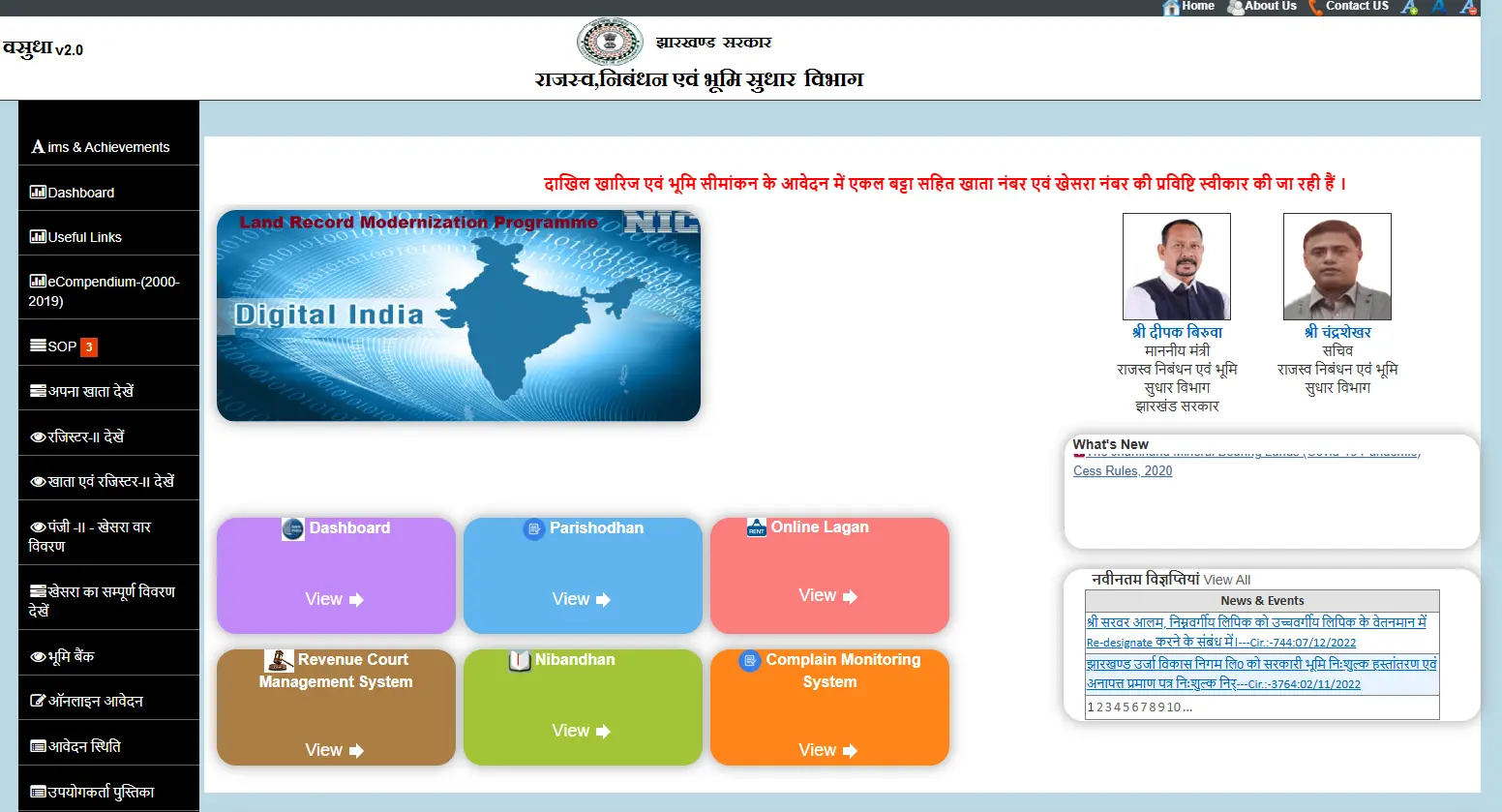
The digitisation of land records in Jharkhand is not merely a technical upgrade; it is a foundational pillar of the ‘Digital India’ initiative that has fundamentally restructured the state’s relationship with its citizens. For decades, land management was a labyrinth of manual registers, opaque processes, and physical barriers that often left the average landowner at a disadvantage. Today, that narrative has been rewritten by Jharbhoomi, the primary digital portal for land information (Bhumi Jankari), overseen by the Revenue, Registration, and Land Reforms Department.
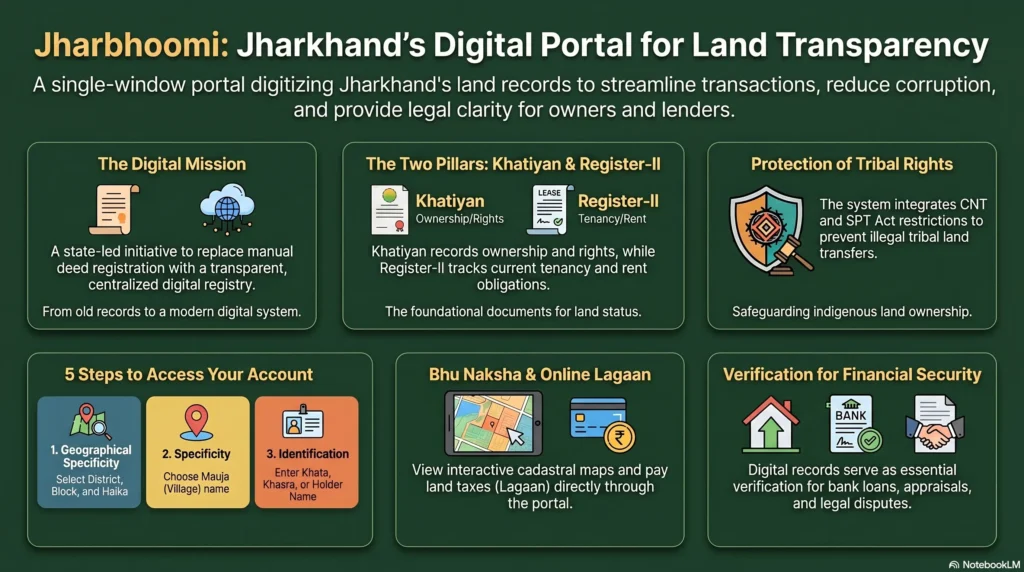
This shift from paper to pixel represents a game-changer for residents. By centralising information and making it accessible through a few clicks, the state has dismantled the “siloed data” architecture of the past. As a senior consultant in e-governance, I have observed that the true value of such systems lies not just in the software, but in the transparency and fiscal accountability they enforce. Jharbhoomi, supported by the sophisticated technical expertise of the National Informatics Centre (NIC), stands as a testament to what is possible when robust ICT infrastructure meets a clear mandate for reform.
Understanding Jharbhoomi: The Digital Gateway to Jharkhand’s Land
The development of the Jharbhoomi portal is rooted in a rigorous mandate: to provide a state-of-the-art ICT infrastructure for the Government of Jharkhand. This mission is spearheaded by the National Informatics Centre (NIC) Jharkhand State Centre, acting under the Ministry of Electronics & Information Technology, Government of India. The NIC has served as the state’s primary technology partner since 2001, a partnership that has matured from basic computerisation to the deployment of complex cloud-based ecosystems.
The Organisational Engine Room
The success of Jharbhoomi is dependent on a multi-layered organisational structure that ensures high-quality service delivery from the state capital down to the most remote districts. This hierarchy is defined by:
- Headquarters (HQ): Led by the Director General and supported by Heads of Groups (HoGs), the HQ provides the strategic vision and national standards for land record digitisation.
- State/UT Centres: Managed by State Informatics Officers (SIOs) and Heads of Departments (HoDs). They are responsible for tailoring national systems like the NGDRS to meet the specific legal and administrative requirements of Jharkhand.
- District Centres: Perhaps the most critical layer, there are 24 District Centres in Jharkhand. These are managed by District Informatics Officers (DIOs) and Assistant District Informatics Officers (ADIOs). The DIO acts as the “boots on the ground,” ensuring that the local Circle Offices (Tehsils) are correctly updating the Jharbhoomi database and that technical grievances are addressed at the source.
This structure bridges the geographical gap in a state with diverse terrain, ensuring that “Bhumi Jankari” is not just a privilege for urban dwellers but a right accessible to every farmer and property owner.
Core Services Provided by Jharbhoomi and Related Portals
Jharbhoomi is the flagship, but it operates as part of an integrated suite of digital platforms. Understanding how these services intersect is vital for any property stakeholder.
ULPIN: The ‘Aadhaar’ for Land
Perhaps the most transformative innovation is the Unique Land Parcel Identification Number (ULPIN). In the past, land parcels were often misidentified due to overlapping survey numbers or phonetic errors in manual registers. The ULPIN assigns a 14-digit alphanumeric ID to every plot, effectively creating a permanent digital identity. This ensures that the centralised database remains the “single source of truth,” preventing fraudulent transactions and duplicate claims.
NGDRS (National Generic Document Registration System)
The NGDRS has revolutionised the deed registration process. It provides a common, scalable software for registration across India, but its implementation in Jharkhand is specifically calibrated to the state’s stamp duty and registration rules. This system allows for online document entry, property valuation based on circle rates, and appointment booking, significantly reducing the “human interface” that traditionally fostered corruption.
e-Daakhil and Mutation Tracking
The e-Daakhil service is where the citizen-centric nature of Jharbhoomi truly shines. Mutation—the process of updating the ownership records after a sale or inheritance—was historically the most delayed aspect of land management. Through e-Daakhil, users can apply for mutation online and track their application status in real-time. This level of transparency ensures that officials are held accountable for processing timelines.
Khasra & Khata: Decoding the Records
To the uninitiated, land terminology can be daunting. In Jharkhand:
- Khasra: This is the specific survey number given to a particular piece of land. It details the area, the soil type, and the crops grown.
- Khata: This refers to the account number belonging to the owner (or owners). A single Khata may contain multiple Khasra numbers if the owner possesses several plots in the same village. Jharbhoomi allows users to search for these records by simply selecting their district, block, and village, providing immediate access to digital RORs (Record of Rights).
The Technical Backbone: NIC Jharkhand’s Infrastructure
Behind the curtain of Jharbhoomi lies a sophisticated arsenal of hardware and software designed to handle millions of transactions without downtime. The NIC Jharkhand Mini Data Centre is the engine room of this operation, providing the foundational “Jharkhand Mini DC Cloud” services.
Hardware Architecture and Data Integrity
The resilience of the system is built upon high-performance hardware that prioritises data safety above all else.
- HPE StoreOnce 5250 Systems: These are not mere storage drives; they are advanced backup and recovery systems. In a land registry, the loss of a single byte of data could lead to a legal catastrophe. The HPE StoreOnce uses data deduplication technology to ensure that backups are efficient and that historical records are preserved with 100% fidelity.
- HCI Clusters and HPE DL385 Gen10 Servers: The system utilizes Hyper-Converged Infrastructure (HCI). This means that compute, storage, and networking are unified into a single software-defined system. The DL385 Gen10 servers, powered by high-performance processors, allow the Jharbhoomi portal to handle heavy traffic loads—such as during peak registration periods—without latency.
- Microfocus DB: This robust database management system handles the complex relationships between ownership data, geographical coordinates, and financial records.
Software Stack and Cloud Orchestration
The software environment is chosen for its stability and security:
- Hypervisor: VMware vSphere 7.0 is used to create and manage virtual machines. This allows the NIC to scale the system’s capacity up or down depending on the demand for services.
- Operating Systems: The servers primarily run on RHEL 8.5 (Red Hat Enterprise Linux), known for its enterprise-grade security, alongside Windows Server 2016 and 2019 for specific application layers.
- Orchestration: VMware vRealize Suite 8.10 manages the cloud environment, ensuring that resources are allocated efficiently across different departments (Revenue, Excise, Transport, etc.) that share the Mini DC infrastructure.
Physical Security: Protecting the State’s Assets
The physical environment of the Mini Data Centre is as secure as its digital one. The facility includes:
- Access Control and CCTV: Multi-layered biometric access ensure only authorised engineers can enter the server room, monitored 24/7 by high-definition surveillance.
- Rodent Repellent Systems: Often overlooked but technically vital, these systems protect the thousands of metres of high-speed fibre-optic and power cabling from environmental damage, ensuring the 24/7 availability of Jharbhoomi.
Technical Glossary for Citizens
- Hypervisor: Software that allows one physical server to act like many “virtual” servers, increasing efficiency.
- Data Deduplication: A process that eliminates duplicate copies of data during backup, saving space and speed.
- HCI (Hyper-Converged Infrastructure): A modern way of building data centres where everything is controlled by software rather than separate hardware boxes.
Integrated Financial Management System (IFMS) & Revenue Flow
The Jharbhoomi portal does not exist in a vacuum; it is deeply integrated with the state’s financial health. The Integrated Financial Management System (IFMS) in Jharkhand is the conduit through which land revenue becomes public funding.
The 2017 Digital Rollout
A critical milestone in Jharkhand’s e-governance history was the rollout of the e-Payment system. Following a successful pilot at the Project Building Treasury from November 2016 to March 2017, the system was implemented across all treasuries on 1st April 2017. This marked the end of physical challans and the beginning of real-time fiscal monitoring.
Process Flow: How Land Revenue Moves
The integration between Jharbhoomi and IFMS creates a seamless “Process Flow” for every rupee collected:
- Online Budget & Allocation: The Revenue department sets its targets and budgets digitally.
- Bill Preparation: When a citizen pays for a mutation or registration, the system generates an e-bill.
- e-GRAS (Real-Time Receipt): The Real-Time Receipt System (e-GRAS) tracks the payment immediately across all departments.
- Payment Gateway Integration: The system is integrated with SBI e-Kuber and the RBI’s e-Kuber platform. This ensures that funds move from the citizen’s bank to the state treasury with total transparency.
- AG Reconciliation: The Accountant General (AG) office receives these accounts digitally by the 5th of every month, allowing for instant audits and reconciliation.
This integration has led to a manifold increase in revenue collection. By removing the requirement for manual “re-entry of voucher data,” the state has eliminated human error and significantly reduced the time required for fiscal planning.
System Comparison: Manual vs. Jharbhoomi
To appreciate the scale of this achievement, one must compare the current portal against the legacy system and private alternatives.
| Category | Old Manual System | Jharbhoomi Online Portal | Private Property Portals |
| Data Authenticity | Low (subject to manual tampering) | High (verified by NIC/State Gov) | Moderate (often rely on scraped data) |
| Update Speed | Very Slow (weeks or months) | Real-time / Immediate | Variable (depends on site updates) |
| Cost of Access | High (travel and manual fees) | Free/Nominal Govt Fees | High (often requires subscription) |
| Legal Validity | Requires manual verification | Legally binding for official use | Information purposes only |
| Infrastructure | Physical Registers (Dusty Archives) | HPE StoreOnce / HCI Clusters | Standard Commercial Cloud |
Key Benefits of Digitisation for the Citizen
From the perspective of a property journalist, the benefits of the Jharbhoomi ecosystem go far beyond “convenience.” It is about the democratisation of data.
- Fiscal Transparency: The system allows for the proper monitoring of expenditures at field-level offices. Citizens can be assured that their fees are reaching the treasury rather than being “lost” in administrative layers.
- Time and Cost Savings: What once took three trips to a district headquarters now takes five minutes on a smartphone. The reduction in “rent-seeking” behaviour is a direct result of this efficiency.
- Mobile-First Progress: The state has even made a Mobile App for Employees functional. This allows field officers (like Halka Karamcharis) to verify land details on-site, further accelerating the verification process for mutations.
- Scalability for Schemes: With real-time availability of state financial data, the government can plan welfare schemes for farmers (based on their Khasra details) with much higher precision.
Step-by-Step Guide: Navigating the Portal
Accessing your ‘Bhumi Jankari’ is a straightforward process, but it is important to know which specific tool to use for your needs.
- Querying Land Records: Visit the main Jharbhoomi portal to view your Khasra and Khata. You can search using the “Apna Khata Dekhen” (View Your Account) link.
- Initiating Mutation: For ownership changes, use the e-Daakhil service. Ensure you have your registered deed number and date ready.
- Registration Appointments: If you are buying property, use the NGDRS link to book an appointment at the registry office after filling in the property valuation details.
- Ancillary Certificates: For income or residency certificates often required in land dealings, use the Jharsewa portal.
- Utilising VC Studios for Grievances: If you face persistent delays at the local level, the NIC infrastructure supports 32+ VC (Video Conferencing) Studios. These studios have hosted 1849 VC sessions and 2338.45 VC hours since October 2021. They are used for VIP sessions and departmental meetings, bridging the geographical gap and allowing district officials to interact directly with state heads to resolve complex land disputes.
Future Outlook: Emerging Technologies in Jharkhand
The NIC’s mandate specifically includes a directive to “Explore & Advise on use of Emerging Technologies.” Jharkhand is uniquely positioned to lead in this space due to its existing communication infrastructure.
Connectivity and Knowledge Networks
The state is currently linked via the NKN (National Knowledge Network) to 19 institutes and via NMEICT to 9 institutes. These high-speed links provide the bandwidth necessary for more advanced technologies like GIS (Geographic Information Systems) mapping and potentially Blockchain-based land registries in the future.
Expanding the Digital Footprint
The success of Jharbhoomi has paved the way for other successful portals managed by the NIC, such as:
- Chancellor Portal: For unified university management.
- VMS for Elections: Ensuring transparent electoral logistics.
- Jharkhand Alumni Portal: Connecting the global diaspora back to the state.
- JSSC & SKIPA: Enhancing recruitment and administrative training.
The state’s move to incorporate policy changes “immediately or even very quickly” into the software demonstrates an agile governance model that is rare in the public sector.
Conclusion
The transformation of Jharkhand’s land records through the Jharbhoomi portal is a masterclass in e-governance. By leveraging a partnership with the NIC that dates back to 2001, the state has built a system that is technically resilient, fiscally transparent, and—most importantly—citizen-centric.
From the high-performance HPE DL385 servers humming in the Mini Data Centre to the farmer checking his ULPIN on a mobile phone, the digital threads of Jharbhoomi are weaving a more equitable future for the state. The integration with IFMS and the RBI e-Kuber system ensures that every transaction contributes to the state’s growth, while the 32+ VC Studios ensure that no citizen is too far from the halls of justice.
As a senior consultant, my advice to the residents of Jharkhand is simple: embrace these digital tools. Use the Jharsewa and e-Daakhil services to secure your property rights and hold the administration to the high standards of transparency that this infrastructure was built to provide. The era of the dusty register is over; the era of Bhumi Jankari is here.