Introduction: Digital Governance in Your Pocket
The management of land records in Karnataka has undergone a monumental shift, evolving from a fragmented, manual system into a world-class model of e-governance. Before the turn of the millennium, the state’s land administration was the sole domain of approximately 9,000 Village Accountants. Each official was responsible for a cluster of three to four villages, acting as the absolute custodian of vital land registers and cadastral maps. Because these accountants were frequently required to travel for field duties, they were notoriously difficult to access. This lack of transparency and physical oversight fostered a culture of inefficiency and systemic corruption.
In the manual era, updating a record following a sale or inheritance was a gruelling process that could take anywhere from one to two years. For the average farmer, navigating this bureaucracy often required the payment of bribes. Historical data suggests that “service fees” for regular updates ranged from Rs. 100 to Rs. 2,000, while deliberate ambiguities or “favours” in the record-keeping could command illicit payments as high as Rs. 10,000. These records were kept in physical registers, shielded from public scrutiny, making it nearly impossible for a landowner to verify the accuracy of their own property data without an official’s “assistance.”
Recognising these failures, the Government of Karnataka conceived the Bhoomi project in 2000. Designed by the National Informatics Centre (NIC) in Bangalore, the portal replaced manual discretion with a standardised, workflow-based software. The transition began with pilot projects as early as 1991 in Gulbarga and expanded to all 177 talukas by 2002. Today, Bhoomi digitises over 20 million land records, empowering 6.7 million farmers. By moving these records into the digital sunlight, the state has eliminated the monopoly of the Village Accountant and created a “Digital-First” environment that places the power of land management directly into the hands of the citizen.
What Exactly is Bhoomi RTC? Breaking Down the Terminology
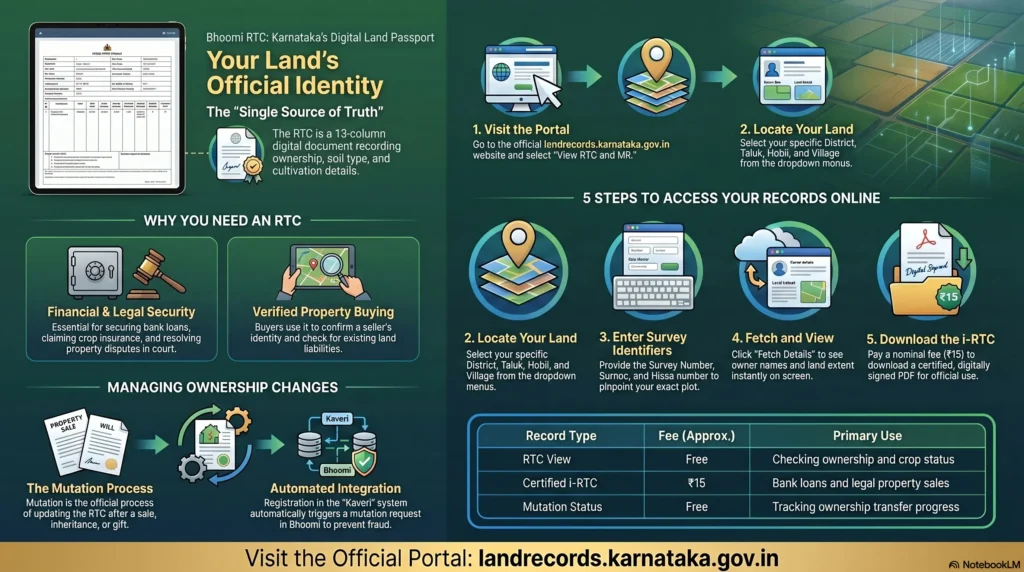
For any property owner or legal professional in Karnataka, “Bhoomi” and “RTC” are foundational terms. “Bhoomi” is the Kannada word for “Land,” while RTC is an acronym for the Record of Rights, Tenancy, and Crops. Locally, this document is most commonly referred to as the Pahani.
The RTC serves as the definitive legal identity for agricultural land. It is not merely a title deed; it is a holistic snapshot of the land’s health, usage, and legal standing. As a Property Law Consultant, I advise clients that an RTC is a living document that must be scrutinised for accuracy across ten specific data points:
- Landowner Details: The primary section identifying the legal title holder(s).
- Soil Type: A classification of the soil quality and composition, which is vital for agricultural planning.
- Type of Land: Whether the parcel is classified as agricultural, commercial, or residential (specifically identifying flood-prone or non-agricultural residential zones).
- Crops Grown: A detailed record of cultivated crops, which is the primary evidence required for processing crop insurance claims.
- Area of Measurement: The exact dimensions of the plot, officially recorded in hectares or acres and signed by a Tahsildar or Deputy Tahsildar.
- Water Rate: Information regarding irrigation sources and the water usage necessary to maintain the land’s fertility.
- Land Classification: Detailed zoning data, including specific categories like “Kharab” land.
- Nature of Possession: A description of how the land is held (e.g., through inheritance, grant, or purchase).
- Liabilities: Crucial for buyers and banks, this section lists any encumbrances, pledges, or outstanding bank loans tied to the property.
- Tenancy Details: Information on any individuals who may be cultivating the land under a tenancy agreement.
Why Keeping Your Land Records Updated is Non-Negotiable
From a legal perspective, the importance of maintaining updated digital records cannot be overstated. According to the Karnataka Land Revenue Act 1964 and the subsequent Karnataka Land Revenue (Amendment) Rules, 2002, the legal landscape changed forever on June 13, 2002.
Consultant’s Professional Warning: The Manual Record Trap
Many older landowners still hold physical, hand-written RTCs provided by Village Accountants decades ago. I must be clear: manually written RTCs have held no legal validity in Karnataka since 2002. If you are attempting to sell property or secure a loan using a manual record, you are holding a document that the government and financial institutions consider worthless. Only computer-generated, authorised RTCs from the Bhoomi portal are recognised for legal purposes.
Why regular updates are essential:
- Proof of Clean Title: A mutation is required to ensure that the RTC reflects the current owner’s name. Without this, the record remains in the name of the previous owner, regardless of whether a sale deed was registered.
- Financial Access: Banks and the state exchequer mandate an updated i-RTC and mutation extract (MR) before approving any agricultural or property-backed loan.
- Market Stability and Investor Confidence: In high-growth real estate markets like Bengaluru and Mysuru, the Bhoomi system has been a boon. Digitisation has stabilised the market by allowing for rapid due diligence. Investors and developers can now perform title checks online, which has significantly reduced the risk of “double-sales” where a fraudulent seller attempts to sell the same plot to multiple parties. This transparency is particularly beneficial for Non-Resident Indians (NRIs) who can manage their holdings from abroad.
Step-by-Step Guide: How to View and Download Your i-RTC Online
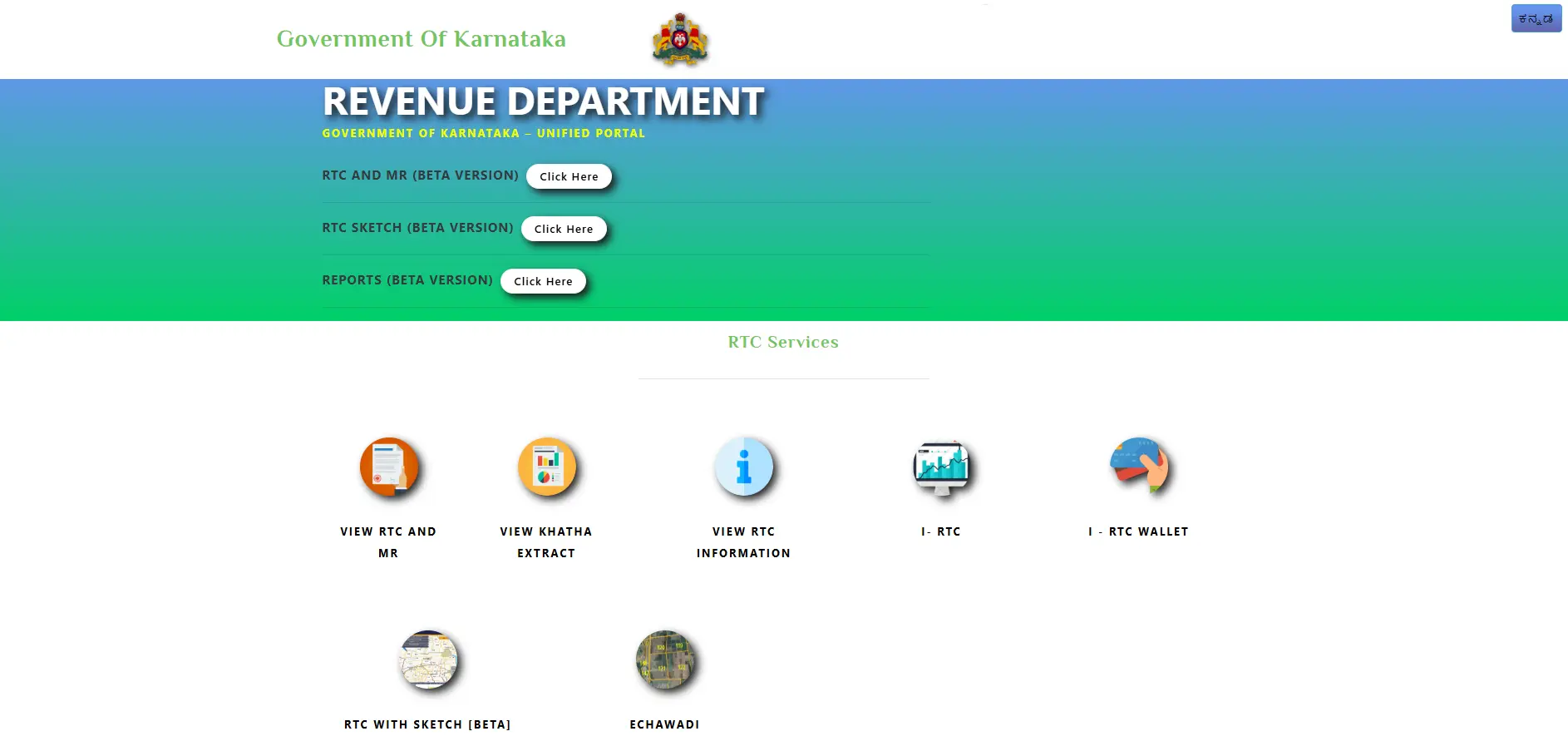
The Bhoomi portal provides an “i-RTC” service—the electronic version of the Record of Rights—which can be accessed “Anywhere-Anytime.” While physical copies can be obtained at one of the 777 Nada Kacheris (village offices) or various tele-centres across the state, the online portal remains the most efficient channel.
The Guest User Workflow:
- Navigate to the Portal: Visit the official Bhoomi Karnataka website.
- Select ‘i-RTC’: Locate the i-RTC option on the homepage. This will redirect you to the citizen portal.
- Login Credentials: Click on “Login as a Guest.” You are required to provide your Name, a 10-digit mobile number, an Email ID, and your Aadhaar Card number.
- Data Input: To fetch the correct record, you must provide the following mandatory fields:
- District
- Taluk
- Hobli
- Village
- Survey Number
- Surnoc (Survey Number Suffix)
- Hissa Number
- Fetch and Review: Click “Fetch Details” to populate the land record data. You can select “View RTC” to see the details on-screen at no cost.
- Payment for Certified Copy: To download a legally valid, digitally signed PDF RTC, click “Pay and Download.”
- The fee is Rs. 10 per i-RTC.
- The portal utilises the SBI online gateway, accepting Net Banking, Credit Cards, and Debit Cards.
- PDF Generation: Once payment is confirmed, the system generates the RTC in a secure PDF format for you to save and print.
Understanding the Mutation Process: Changing Property Titles
Mutation is the legal administrative process of recording a change in property title. It is the bridge between the registration of a deed and the official updating of the RTC. This process is triggered by sale, inheritance, gift, partition, or government acquisition.
The Procedural Workflow:
- Submission: Applications are typically submitted at a Bhoomi Kiosk or Taluk office. You must provide the sale deed, identity proof, and, in cases of inheritance, proof of relationship.
- Notice Issuance: Once the Kiosk issues an acknowledgement number, the system generates notices. The Revenue Inspector (RI) is legally required to serve these notices to all “interested parties” and, importantly, must paste a copy of the notice at the village office to ensure public visibility.
- The 50-Day Rule: The Bhoomi system is designed for efficiency. If the RI does not complete the mutation within 50 days, the applicant has the legal right to approach a superior officer at the Taluk level to authorise the transaction and expedite the process.
- Final Approval: If no objections are raised during the mandatory 30-day notice period, the RI passes the final acceptance order, and the textual record is updated.
Citizens can track this journey through the “Mutation Status” portal using their acknowledgement number, following the application through 13 different stages via automated SMS alerts.
The Phodi Process: Integrating Survey and Textual Records
One of the most complex aspects of land management is the “Phodi” process—the survey and subdivision of land. Historically, “Mutation” (the name change) and “Phodi” (the physical boundary change) were handled by different departments at different times, leading to massive backlogs and records that didn’t match the actual maps.
The Integrated Mutation Phodi Workflow
The Government of Karnataka has now modernised this through “Integrated Mutation Phodi.” This system ensures that textual records (Bhoomi) and spatial records (Revenue Maps) are updated simultaneously by the same officer.
- Kiosk Operator Role: When you submit a mutation involving only a part of a land parcel, the operator requires a pre-mutation survey sketch (Form 11E).
- RI Provisional Consent: After the notice period, the Revenue Inspector gives “Provisional Consent” if no disputes exist. Once this consent is given, the RI cannot rescind the decision.
- Survey Supervisor Role: The transaction is then electronically pushed to the Survey Supervisor. They verify the 11E sketch and assign new final subdivision numbers directly onto the sketch.
- Final Synthesis: The Survey Supervisor updates the Akarbandh, Tippan, and Atlas. This information is sent back to the Bhoomi back-end, where a Data Entry Operator (DEO) scans the new sketch. The final result is a new RTC with a unique survey number and a matching spatial map, effectively eliminating future boundary disputes.
Advanced Features: Kaveri, Bank, and Land Acquisition Integration
The Bhoomi portal is the heart of an integrated digital ecosystem, connecting various government arms to prevent fraud.
Tight Integration with Kaveri
Bhoomi is “tightly integrated” with Kaveri, the registration software. Before a Sub-Registrar allows a sale to proceed, the Kaveri system pings the Bhoomi database in real-time. It checks for government restrictions, ensuring that the seller truly owns the land and that the plot is not “Gomala” (pasture land) or otherwise restricted. This “tight integration” has been implemented across 247 Sub-Registrar Offices to stop fraudulent sales at the source.
Bhoomi-Bank Integration
This feature has revolutionised agricultural lending. Bankers no longer rely on manual certificates. They access RTC information online to verify the owner’s share and existing liabilities.
- Charge Creation: When a loan is granted, the banker creates a digital “pledge” online.
- Revenue Approval: The RI reviews the digital request and approves it, ensuring the pledge appears on the RTC within 3 to 4 working days. This prevents a landowner from taking multiple loans from different banks on the same parcel of land.
Land Acquisition Integration
To protect innocent buyers, Bhoomi is integrated with acquisition authorities. As soon as a 4(1) or 6(1) notification is issued for public projects (like a highway), the details are automatically reflected in the RTC. This prevents a seller from offloading land that is already slated for government takeover.
Navigating the Bhoomi Portal Services: A Comprehensive List
The portal is a multifaceted tool for property owners. Below is a breakdown of the primary services:
| Service Category | Operational Description |
| i-RTC | Download digitally signed Record of Rights (PDF). |
| Mutation Register | View the record of ownership changes and historical transfers. |
| Mutation Status | Track the 13-stage progress of a pending application. |
| Revenue Maps | Download cadastral village maps showing plot boundaries. |
| Dispute Case Reports | Access reports on pending legal cases for a specific Taluk. |
| XML Verification | A tool for third parties to verify the authenticity of a printed RTC. |
| Tippan | Access survey measurement documents for specific plots. |
| Bhu Suraksha | Access the scheme for converting manual records to digital (7-day guarantee). |
| RR5 / RR6 | Access specific registers related to land rights and possession. |
| New Taluk Lists | Updates on administrative boundaries for newly formed regions. |
Competitor Analysis: Bhoomi (Karnataka) vs. Meebhoomi (Andhra Pradesh)
While Karnataka was a pioneer in 2000, Andhra Pradesh followed with its Meebhoomi portal in 2015. Both systems are excellent examples of digital governance, but they differ in terminology and specific features.
Narrative Comparison
Karnataka uses the term Pahani (RTC), while Andhra Pradesh uses Adangal. In AP, the primary ownership document is the ROR 1B. Both states have focused on Aadhaar integration and “E-Passbooks” to summary holdings. However, Karnataka’s Bhu Suraksha initiative is specifically aimed at digitising the final remnants of manual archives with a 7-day service guarantee.
Andhra Pradesh’s Saswatha Bhoomi Hakku is a resurvey-focused project utilizing drones and modern technology to provide “Permanent Property Rights” across 17,000 villages. In terms of mapping, Karnataka provides Tippans and Revenue Maps, while AP provides Field Measurement Books (FMB) and Village Maps.
Feature Comparison Table
| Feature | Karnataka (Bhoomi) | Andhra Pradesh (Meebhoomi) |
| Primary Document | RTC / Pahani | Adangal / ROR 1B |
| Launch Year | 2000 | 2015 |
| Certified Copy Fee | Rs. 10 (Online) | Rs. 25 (Online) |
| Survey Map Document | Tippan / Revenue Map | FMB / Village Map |
| Mobile App | m-Bhoomi / Citizen App | Meebhoomi App |
| Security | Biologon Fingerprint Auth | Aadhaar-linked E-Passbook |
Fees and Charges: A Quick Reference
Bhoomi is a self-sustained project. The fees collected are used for hardware maintenance and infrastructure.
| Document Name | User Fee (at Kiosk / Nada Kacheri) | Online Fee (i-RTC) |
| RTC (Pahani) | Rs. 10/- | Rs. 10/- |
| Mutation Extract (MR) | Rs. 15/- | N/A |
| RR5 / RR6 | Rs. 15/- | N/A |
| Mutation Status | Rs. 15/- | Free (View) |
| Tippan | Rs. 15/- | N/A |
Troubleshooting: Common Challenges and Pro-Tips
Navigating land records can be tricky. As a specialist, I recommend the following:
- The Hissa/Surnoc Accuracy: Most “Record Not Found” errors are due to incorrect Surnoc or Hissa numbers. Ensure these are verified from a previous document before searching.
- The “Worthless” Manual Document: If you are buying land and the seller produces a manual RTC, treat it as a red flag. Insist on a computerised, digitally signed i-RTC.
- Pending Mutations: Always check the “Mutation Status” before paying a deposit. If a mutation is pending or “disputed,” the title is not clear.
- Bhu Suraksha Scheme: If your land is not yet on the digital portal, do not panic. Use the Bhu Suraksha 7-day guarantee at your local Taluk office to force the digitisation of your manual archives.
- Biometric Security: The Bhoomi system uses Biologon finger print authentication for all revenue officials. This ensures that no unauthorized person can alter your land data, providing a high level of security against internal fraud.
Frequently Asked Questions (FAQs)
What is the difference between an RTC and a Mutation Extract?
Think of the RTC (Pahani) as your current “Account Balance”—it shows who owns the land right now. The Mutation Extract (MR) is the “Transaction History”—it shows the specific details of how the ownership changed (e.g., from Person A to Person B via sale).
How do I link my Aadhaar to my land records?
You can visit the official Bhoomi portal and navigate to the ‘Aadhaar/other identities’ section. Linking your Aadhaar is crucial for receiving SMS alerts and securing your property against impersonation.
Is the online view of the RTC valid for bank loans?
No. The “View” option is for informational purposes only. For bank loans or legal transactions, you must pay the Rs. 10 fee and download the digitally signed PDF (i-RTC).
What should I do if my mutation isn’t approved within 50 days?
Under Bhoomi guidelines, if the RI doesn’t act within 50 days, you should approach a Taluk-level officer. The system is designed to prevent “pick and choose” corruption through a Strict FIFO (First In First Out) strategy.
How does the Biologon authentication protect my data?
Every official accessing the Bhoomi database must use their fingerprint. This creates a permanent, unalterable log of who changed what, ensuring accountability and preventing unauthorized database tampering.
Conclusion: The Future of Land Management
The transformation of land records in Karnataka is a testament to the power of digital governance. From the days of the 9,000 Village Accountants and their private registers to a transparent portal serving millions, the state has set a national benchmark. The shift to a “Digital-First” environment has not only saved citizens from the burden of bribery and delays but has also built a more reliable real estate market.
As we move toward 2026, the focus is on 100% paperless records through the Bhu Suraksha initiative and the total integration of textual and spatial data. For every farmer and property investor, the Bhoomi portal is more than just a website; it is a shield against fraud and a tool for economic empowerment. Keeping your records updated is no longer just a recommendation—it is the cornerstone of property ownership in the digital age.