
Welcome to the Digital Age of Land Ownership
For decades, the standard for land verification in Maharashtra involved navigating stacks of manually written ledgers in local revenue offices. Today, that world has changed. Through the Digital India Land Records Modernization Programme (DILRMP), the Maharashtra Revenue Department has successfully transitioned to the Mahabhulekh (Maharashtra Bhumi Abhilekh) portal.
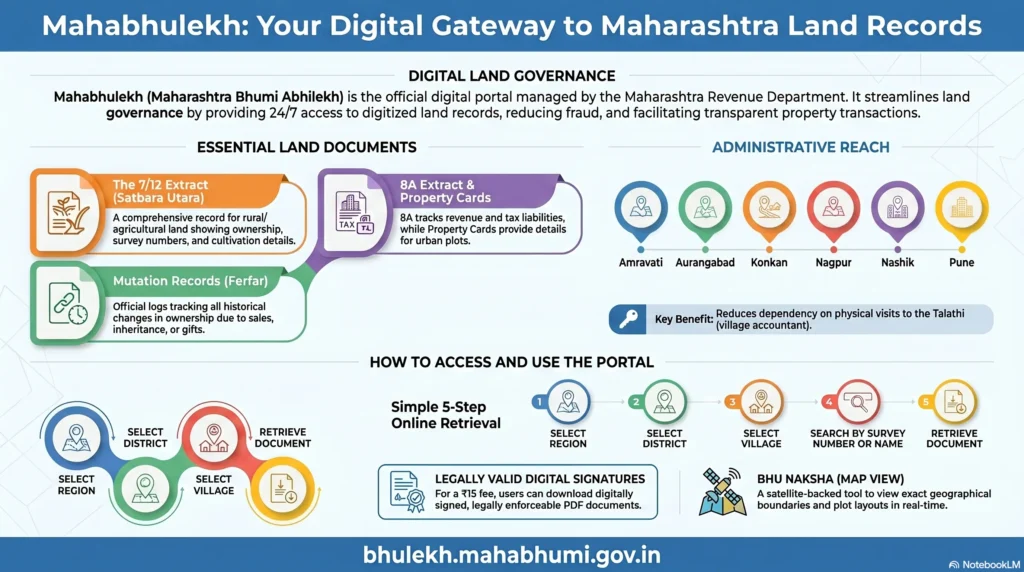
As a senior consultant in this space, I have seen how this digital window empowers the average citizen. You no longer need to depend on intermediaries to verify a seller’s claims or check your own holdings. Whether you are a farmer, a homebuyer in Pune, or an investor looking at Nagpur’s industrial corridors, this portal is your primary tool for securing your property legacy.
Decoding the “Big Three”: 7/12, 8A, and Property Cards
To use Mahabhulekh effectively, you must understand the specific technical components of the documents you are viewing. These are not just lists of names; they are legal snapshots of rights and liabilities.
7/12 Extract (Satbara Utara)
This is the primary record for rural and agricultural land. It is a combination of Village Form 7 (Record of Rights) and Village Form 12 (Register of Crops). When you look at a 7/12, pay close attention to these technical fields:
- Survey and Hissa Numbers: The Survey/Gat number identifies the plot, while the Hissa Number indicates the specific sub-division of that plot.
- Bhudharana Paddhiti (Occupancy Class): Class 1 owners have unrestricted alienable rights. Class 2 owners (often occupants of government-granted land) face restrictions on transferring the property without prior permission.
- Potkharaba: This refers to the portion of the land that is uncultivable or unfit for farming.
- Aakarni & Judi Tax: These represent the assessment tax and special revenue paid to the government.
8A Record
While the 7/12 focuses on a specific plot, the 8A Record is a revenue register. It tracks the total land held by an individual across various survey numbers in a village, their account number (Khate Kramank), and their total tax assessment. It is the essential “financial balance sheet” of your land holdings.
Property Card (Malmatta Patrak)
In urban areas like Mumbai or Thane, the 7/12 is replaced by the Property Card. It identifies land by its City Survey (CTS) number and is the conclusive proof of ownership for non-agricultural plots.
Comparison of Core Land Records
| Purpose | Data Source | Ideal Use Case |
| 7/12 Extract | Ownership & Agricultural Usage | Agricultural loans, verifying crop patterns, rural sales. |
| 8A Record | Financial/Tax Assessment | Revenue division among co-owners, tax liability checks. |
| Property Card | Urban Title Verification | Verifying city plots or shop ownership in urban areas. |
Step-by-Step: How to Use the Mahabhulekh Portal
The portal experience is divided into two distinct phases: Viewing (Free) and Downloading (Paid).
Phase 1: Viewing Records for Free
- Visit the official viewing portal: bhulekh.mahabhumi.gov.in.
- Select Region: Choose from the six revenue divisions (Pune, Konkan, Nashik, Nagpur, Amravati, or Aurangabad).
- Search Parameters: Enter the District, Taluka, and Village.
- Language Note: To search by “Owner Name,” you must type the name in Marathi. Most consultants recommend searching by Survey/Gat number for higher accuracy.
- View: Complete the CAPTCHA to see the “Unsigned” copy.
Phase 2: Downloading Legally Valid Copies If you need a document for a bank loan or court matter, a simple view is not enough.
- Navigate to the DigitalSatbara portal: digitalsatbara.mahabhumi.gov.in.
- Register as a new user and log in.
- Pay the Fee: A payment of ₹15 per extract is required.
- Download: Once paid, you can download the Digitally Signed copy. Important: These downloads are typically available for 72 hours from the time of payment.
Focus: Accessing 7/12 Extract in Nagpur
Nagpur has reached a milestone where over 99% of land records are now digitized and digitally signed. When accessing records in the Nagpur Division:
- Ensure you have the Gat Number or Hissa Number ready for the specific plot.
- Nagpur’s 7/12 records are particularly detailed in Village Form 12, providing precise data on irrigation types (well-irrigated vs. rain-fed) and cultivation details for the most recent season.
- As an expert tip: Always cross-verify the Mutation Number (shown as a circled number) against the latest transaction to ensure the record reflects the current owner.
Why the DILRMP Matters to You
The Digital India Land Records Modernization Programme (DILRMP) is shifting India from a “presumptive” titling system (where ownership is assumed based on possession/tax records) to a “conclusive” system (where the government guarantees the title). By 2026, the Integrated Land Information Management System (ILIMS) aims to provide a real-time, tamper-proof environment.
Direct Benefits for Citizens:
- Middleman Elimination: Direct access to portals like Mahabhulekh removes the need for revenue office agents.
- Precise Boundaries: Modern satellite and GIS mapping ensure that your plot’s dimensions are accurate to the centimeter.
- Reduced Fraud: Digitally signed records are difficult to forge and are accepted instantly by financial institutions.
- Mutation Efficiency: The “e-Ferfar” system automates the queuing of record updates following a sale registration.
- Financial Inclusion: Clear, digital titles make it significantly easier for farmers to secure Kisan Credit Cards and crop insurance.
The Ecosystem: Related Portals and Services
Mahabhulekh is part of a larger digital infrastructure. As a buyer or owner, you should be familiar with these supplementary platforms:
| Platform Name | Best For | Official/Third-Party |
| Aapli Chawadi | Digital notice board; viewing public notices for pending mutations. | Official (State) |
| Aaple Sarkar | Applying for official non-agricultural (NA) orders or fresh 7/12. | Official (State) |
| Digitalsatbara | Downloading legally valid, ₹15 signed copies. | Official (State) |
| UMANG App | Mobile access to land records on the go. | Official (Federal) |
| mypatta | Accessing certified copies of Sale Deeds and transaction history. | Third-Party |
| Maha Bhu Naksha | Viewing georeferenced, satellite-backed land maps. | Official (State) |
Modern Innovations: Vertical 7/12 and the Live Campaign
As of 2025-2026, two key initiatives have changed urban property management:
- Vertical 7/12 Yojna (June 2025): Traditionally, 7/12s only mapped the horizontal surface. This scheme now issues separate extracts for individual floors in multi-story buildings, providing absolute clarity for apartment owners.
- Live 7/12 Campaign (Jivant 7/12): Launched in April 2025, this program ensures that records are updated in real-time, aiming for zero lag between a physical event (like a crop harvest or land sale) and its digital reflection.
Mutation (Ferfar): Tracking Your Change of Ownership
“Mutation” is the legal process of updating the government record after a property transfer. The Professional Warning: Registration of a sale deed at the Sub-Registrar Office (SRO) does not instantly update your 7/12. There is a mandatory verification and notice period. You can track this progress through the e-Ferfar status page:
- Enter your Application Number or Document Number.
- The system will show the status of the mutation entry.
- Check Aapli Chawadi to see if any public objections have been raised during the notice period.
Troubleshooting Common Mahabhulekh Hurdles
If you encounter errors in your record, do not ignore them. Even a minor spelling mistake can stall a future sale.
| Common Issue | Practical Solution |
| Spelling or Area Errors | Apply for correction via the e-Haq portal. You must upload the old handwritten record as proof. |
| Plot Not Found | The village data may not be fully digitized. Visit the local Talathi office with your manual records. |
| Server Lag | Avoid peak hours (10 AM – 2 PM). Use browsers like Chrome or Edge with cleared caches. |
| Missing Mutation | Ensure the 15-day public notice period on Aapli Chawadi has concluded. |
Security and Validity Check
While machine-aided transliteration is provided on the portal for convenience, the Marathi version of the land record is considered sacrosanct (official) in any legal dispute.
Validity Checklist:
- Only Digitally Signed extracts are valid for bank or legal use.
- Each signed extract contains a unique verification number. Verify this on the portal to ensure the PDF hasn’t been tampered with.
- Remember that a downloaded copy is a snapshot in time; it is always best to generate a fresh copy before any major transaction.
Frequently Asked Questions (FAQs)
Is the online 7/12 legally valid?
Yes, provided it is the “Digitally Signed” version. Unsigned “view-only” copies are for informational purposes only.
What is the fee for a digital copy?
The fee is ₹15 per extract, payable online on the DigitalSatbara portal.
Can I get a property card for urban land?
Yes, urban and non-agricultural areas in cities like Mumbai use Property Cards (Malmatta Patrak) instead of 7/12 extracts.
What is a CTS number?
It stands for City Title Survey number, which is the unique ID for urban plots found on the Property Card.
How do I fix a wrong name on my 7/12?
You can apply for a correction through the official e-Haq system on the Mahabhulekh website.
What are “encumbrances”?
These are legal or financial claims against the land, such as a bank mortgage or a pending court case. These must be cleared for a “clear title.”
How long is the download valid?
Once you pay for a digitally signed copy, you usually have 72 hours to download the file.
What if my plot is not visible on Bhu Naksha?
This typically means the cadastral mapping for that specific village/gat is still being updated or digitized.
Final Thoughts: Securing Your Legacy
The Mahabhulekh portal has moved power from the bureaucrat’s desk to the citizen’s fingertips. However, digital access comes with the responsibility of digital vigilance. I recommend that every landowner check their 7/12 and 8A records at least once a year to ensure no unauthorized changes have occurred and that all mutation entries are correctly certified.
Staying updated with your land records is the single most effective way to safeguard your property rights and avoid long-term legal complications.
Technical Support & Helpdesk
- Phone: 020-26050006
- Email: help.mahabhumi@gmail.com / dlrmah.mah@nic.in
- Official Portal: bhulekh.mahabhumi.gov.in