Introduction: Why Your Land Records Might Be at Risk
Listen closely, because as a property consultant who has spent decades navigating the corridors of Haryana’s revenue departments, I’ve seen countless families lose their life’s savings over a single word in a ledger. As we approach the milestone of 2026, the stakes for landowners in Haryana have never been higher. For years, there has been a massive misunderstanding among the public regarding what actually constitutes “proof of ownership.”
If you own a plot in Gurgaon, a field in Rohtak, or industrial land in Faridabad, you likely know the word “Jamabandi.” It is the Register of Rights, the ultimate document. However, thousands of residents are currently listed under “Khana Kasht”—a column that refers only to cultivation or physical possession. With the state-wide digital overhaul and the Haryana Land Records 2026 updates, the government is making it clear: if your name isn’t in the ownership column, your legal claim is paper-thin.
WARNING: POSSESSION IS NOT OWNERSHIP
Under the Haryana Land Revenue Act and the clarified legal position governing Jamabandi Haryana, “Khana Kasht” entries reflect possession or cultivation only. They DO NOT confer ownership. Your ownership rights are only legally recognized when the ownership column is corrected through a sanctioned Ownership Mutation. Physical possession without this legal entry is a recipe for disaster.
Understanding Jamabandi and the Web-HALRIS Revolution
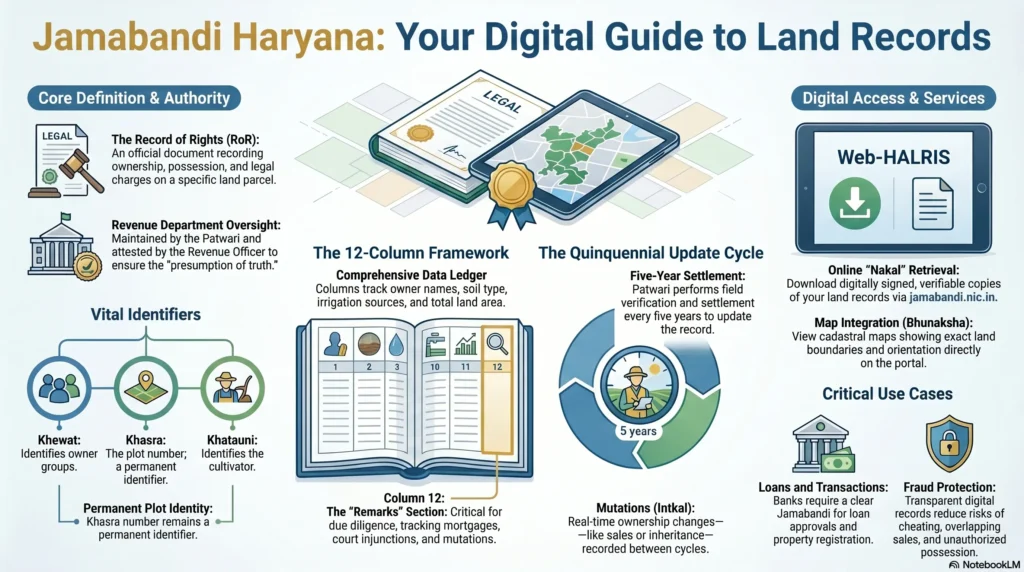
In my years on the ground, I’ve seen the transition from dusty, thumb-printed registers to the sleek interface of Web-HALRIS (Haryana Land Records Information System). This is not just a website; it is a workflow-based revolution implemented across all 143 Tehsils and sub-Tehsils in the state. It has been built with an “Antyodaya” philosophy—ensuring the most vulnerable citizen can secure their rights without falling prey to middlemen.
The Core Modules of Web-HALRIS:
- Deed Registration: This is where it starts. Integration with e-GRAS for E-Stamping allows you to generate and verify stamps online, preventing the old-school fraud of backdated papers.
- Jamabandi: The final, authoritative record of rights.
- Mutation: The vital bridge that moves a name from the “Buyer” list to the “Owner” column.
- Khasra Girdawari: The harvest record, now managed via tablet-based e-Girdawari for real-time field reporting.
- Integrated Dashboards: Allowing departments like Town and Country Planning and HUDA to talk to each other.
The sheer scale is staggering. The system currently handles over 3,000 registrations and 10,000 Nakals (copies) every single day. More importantly, it processes 2,000 mutations daily. This massive volume means that Haryana Land Records 2026 are becoming cleaner, but it also means that “hidden” discrepancies like Khana Kasht correction issues are being flagged by the system automatically.
The “Khana Kasht” Crisis: Why 2026 is a Turning Point
The crisis we face is one of “Incomplete Titles.” Many buyers in the 80s and 90s executed sale deeds (registries) but never followed through with the mutation. They took possession, built houses, or farmed the land. In the revenue records, they were entered in the “Kasht” (cultivation) column. This was fine in a slower, manual era. But today, a title that shows physical possession but lacks ownership is a “flagged” property.
The Risks of Inaction
- Overlapping Sales: Fraudsters look for properties where the registered owner in the record is different from the person in possession. They then “re-sell” the land using old records, leading to decades of litigation.
- Denial of Credit: Banks are now using Web-HALRIS for due diligence. If your name is only in the “Khana Kasht” column, your loan application for a home or business will be rejected outright.
- Litigation Management System (LMS) Flags: The government’s LMS now monitors over 4.23 lakh court cases. If your land is part of a joint holding (Khewat) and a co-sharer goes to court, your possession-only entry gives you almost no standing to protect your specific portion.
Scenarios Requiring Urgent Correction
You must seek a Khana Kasht correction if:
- You have a sale deed but the ownership column still shows the seller’s name.
- A family partition (Taksim) happened physically, but the Jamabandi still shows “joint ownership.”
- You inherited land and are tilling it, but the “Mutation of Inheritance” was never sanctioned.
- You are planning a sale or Property Verification Gurgaon and realize your name is in the wrong column.
The Statutory Mutation Procedure: A Deep Dive
Correcting your record isn’t just about “updating a name.” It is a legal, statutory process under the Haryana Land Revenue framework. As a consultant, I tell my clients to view this as a five-step shield for their property. Here is the process in detail:
Step 1: Submission of Application and Title Documents
The process begins with an application for Ownership Mutation. You cannot simply ask for a change; you must provide a “Source of Right.” This is usually a registered sale deed, a court decree, or a certified partition deed. This application is now increasingly digitized through the Web-HALRIS portal. Many people make the mistake of assuming the Registry (deed) is the final step. It isn’t. The mutation is the administrative recognition of that deed. You must ensure all original documents are scanned and uploaded accurately to avoid initial rejection.
Step 2: Verification of Records (The “Fard” Check)
Once the application is in, the revenue officials—specifically the Patwari and Kanungo—verify the existing Jamabandi Haryana records. They check for “encumbrances.” Is the land mortgaged? Is there an injunction from the Litigation Management System (LMS)? They cross-reference the Khasra numbers (plot numbers) to ensure the land described in your deed matches the land available in the ownership column. This is a critical bottleneck where discrepancies in area (even a few yards) can stall the process.
Step 3: Issuance of Public Notice
This is a mandatory transparency step. The department issues notices to all co-sharers and “interested persons.” In many villages, the Nambardar (village head) is informed to announce the mutation. This is designed to prevent fraudulent transfers. If you are correcting a “Khana Kasht” entry to ownership, the current recorded owners (who might be the people you bought the land from decades ago) are notified. If no objections are raised within the statutory period, the process moves forward.
Step 4: Personal Hearing Before the Revenue Authority
The Assistant Collector (Tehsildar/Naib-Tehsildar) holds a personal hearing. This is where the “Senior Property Consultant” advice becomes vital: you must be prepared to prove your “continuous possession” and the validity of your title documents. The authority examines whether the Khana Kasht correction is justified based on the evidence. If there are co-sharers, they may be asked to verify the partition. This step ensures that the mutation is “sanctioned” in a quasi-judicial manner, making it very hard to challenge in the future.
Step 5: Passing of the Reasoned Order and Updating Jamabandi
If the authority is satisfied, they pass a “Reasoned Order.” This order specifically directs the revenue staff to move the entry from the cultivation column to the ownership column. The Ownership Mutation is then recorded in the “Register of Mutations” and subsequently reflected in the next quinquennial (five-yearly) Jamabandi. Only once this step is complete is your title considered “clear” and “marketable.”
Competitor Analysis: Government Portal vs. Manual Methods
Many landowners still think they can “manage” their records through the old manual system or third-party brokers. This is a dangerous misconception.
Competitor Comparison Table
| Feature | Official Jamabandi Portal (Web-HALRIS) | Manual/Legacy Process |
| Transparency | High: All records, scanned mutations, and deeds are online. | Low: Dependent on physical ledgers and the Patwari’s availability. |
| Fraud Prevention | Superior: Integrated with HUDA, HSIIDC, and the Forest Dept to block illegal registrations. | Weak: Easy to create “overlapping” or backdated entries in physical books. |
| Speed & Accuracy | Fast: Handles 3,000+ daily registrations with digital signatures. | Slow: Subject to physical movement of files and manual error. |
| Security | Certified: Integration with e-GRAS ensures stamp duty is verified/defaced. | Vulnerable: Physical stamps can be forged or reused. |
| Litigation Status | Live: Integrated with High Court and Subordinate Court data via LMS. | None: Manual searches often miss pending litigation. |
District and Tehsil Focus: A State-Wide Mandate
The requirement for Ownership Mutation is not limited to big cities; it is a universal mandate across all 22 districts.
- Ambala & Panchkula: As these areas see a rise in residential development, securing ownership entries for “abadi” (residential) and agricultural land is vital to avoid urban land grabs.
- Faridabad & Palwal: With the massive industrial corridor expansion, “possession-only” entries are being challenged by developers and government acquisitions alike.
- Rohtak, Sonipat & Panipat: The heart of the agricultural belt. Here, Khana Kasht correction is essential for farmers to access “Meri Fasal Mera Byora” benefits and direct bank transfers.
- Hisar, Sirsa & Fatehabad: Rural land records must be aligned to ensure that inheritance cases (Virast) are correctly mutated to the new generation.
- Karnal, Kurukshetra & Yamunanagar: Regularising title discrepancies here is the only way to prevent prolonged civil litigation over shared family boundaries.
- Rewari, Mahendragarh & Jhajjar: Strategic locations where land values are skyrocketing; don’t let a “Khana Kasht” entry be the reason your land is flagged as disputed.
- Nuh, Jind & Kaithal: Vital to follow the formal revenue procedure to ensure your Jamabandi reflects your actual legal status.
Deep Dive: The Tehsils of Gurugram (Gurgaon)
In my consulting practice, Property Verification Gurgaon is the most requested service. The value of land here is so high that even a minor record error can cost crores.
- Gurgaon Tehsil: The urban core. Here, sale and inheritance mutations are scrutinized heavily. If you bought land in an urban village and are only in the cultivation column, you are at risk of being blocked from further sale.
- Badshahpur & Wazirabad: These are the hotspots for high-rise developments. Integration with HUDA and Town & Country Planning means that builders will not touch land that doesn’t have a clean ownership mutation.
- Sohna & Manesar: As industrial and expressway hubs, these tehsils see high government acquisition. To receive compensation, you MUST be in the ownership column. Possession (Khana Kasht) alone won’t get you the cheque.
- Pataudi & Farrukhnagar: Transitioning from traditional agriculture to peri-urban land. Many old family holdings still show cultivation entries; these must be corrected before the 2026 deadline to ensure legacy protection.
Beyond Land Records: The Integrated Haryana Digital Ecosystem
Jamabandi Haryana is the heart, but the state has built a massive body of services around it.
Parivar Pehchan Patra (Family ID) With 59 lakh families already collated and 24 lakh verified, the Family ID is the “Golden Record.” All land records are being linked to your PPP. This allows the state to proactively deliver services based on your socioeconomic status. If your land records aren’t accurate, your PPP benefits could be impacted.
Meri Fasal Mera Byora (MFMB) Over 7.7 lakh farmers are registered. This portal integrates directly with land records. If the ownership in Web-HALRIS doesn’t match the farmer reporting the crop, procurement payments are held up. Correcting your mutation is literally a matter of getting paid for your harvest.
Litigation Management System (LMS) The state government is a party in over 4.23 lakh cases. By integrating with the High Court, the government can now see if land is under litigation in real-time. If you are only in the “Khana Kasht” column during a court case, you lack the legal standing of a “Title Holder,” which can be fatal in injunction hearings.
Antyodaya SARAL Winner of the Gold Award for excellence, SARAL offers 542 schemes across 39 departments. All these—from old age pensions (28 lakh beneficiaries) to ePDS (1.24 crore beneficiaries)—rely on the integrity of your identity and your assets.
Step-by-Step: How to Verify Your Title Today
Don’t wait until you’re at the registration office to find a problem. Use this Action Plan for Khana Kasht correction today:
- Access the Portal: Visit https://jamabandi.nic.in.
- Generate a Nakal: Search by your Khewat, Khatoni, or Name. Look at Column 4 (Ownership) and Column 5 (Possession/Cultivation).
- Cross-Verify with Scanned Mutations: The portal provides scanned copies of previous mutations. Check if your last transaction (Registry) was actually “sanctioned” and “entered.”
- Check for “Fard-e-Badr”: Look for any “correction orders” that might have been issued but not implemented.
- Identify Discrepancies: If you see your name in the cultivation column but the seller’s name in ownership, you need an Ownership Mutation immediately.
Conclusion: Securing Your Legacy
The era of “possession is nine-tenths of the law” is over in the digital age of Haryana Land Records 2026. In the modern Web-HALRIS system, the only law that matters is what is written in the ownership column of your Jamabandi.
Relying on a “Khana Kasht” entry is a gamble with your family’s future. It leaves you open to fraudulent overlapping sales, excludes you from the benefits of the digital ecosystem like “Meri Fasal Mera Byora,” and leaves you defenseless in the Litigation Management System.
Proper mutation is the final, essential step of property ownership. Whether you are in the busy streets of Gurgaon or the fertile fields of Sirsa, I strongly advise you to verify your records today. If you find your title is incomplete, consult a legal expert in your local tehsil to initiate the statutory correction process. Secure your records, verify your title, and ensure your legacy is protected before the administrative shifts of 2026 take full effect. Your land is your most valuable asset—make sure the law agrees that it’s yours.