Introduction: The Digital Transformation of Odisha Land Records
The landscape of property ownership in Eastern India has undergone a radical shift, moving from the opaque physical registers of the past to a transparent, real-time digital ecosystem. Today, the Bhulekh Odisha portal stands as the definitive digital repository for the state’s land administration. Managed by the Revenue and Disaster Management Department in collaboration with the National Informatics Centre (NIC), this portal serves as the cornerstone of the Digital India Land Records Modernisation Programme (DILRMP).
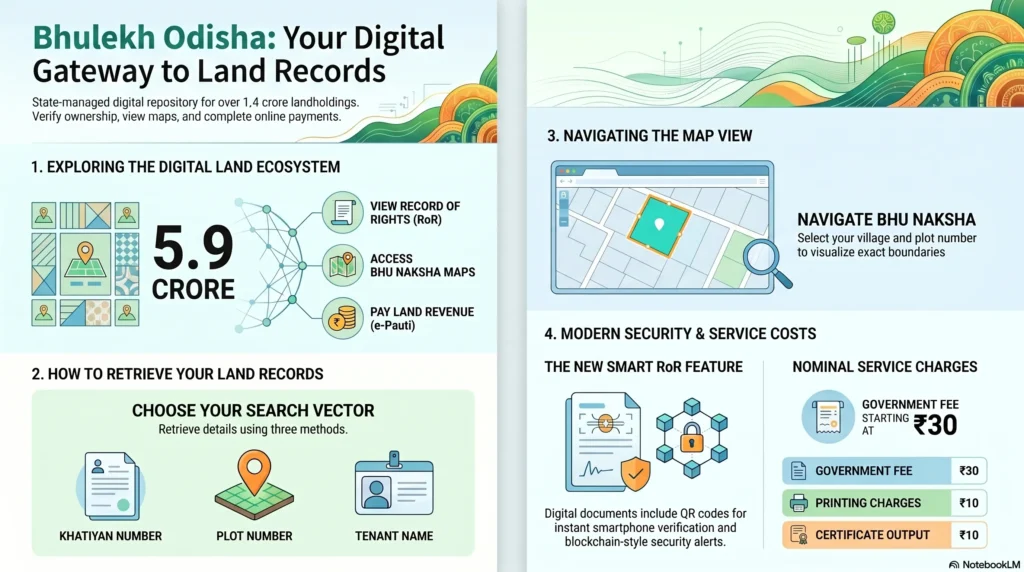
For decades, land records were vulnerable to manual errors, tampering, and bureaucratic delays. The transition to a digitised framework has decentralised information, empowering homeowners, land buyers, and legal researchers to verify ownership from their homes. As we enter 2026, the system has reached a new peak of security with the introduction of “Smart RORs” featuring encrypted blockchain-style security and instant QR code verification. Whether you are verifying a plot for a home loan or researching historical ownership, this guide provides a strategist’s roadmap to mastering Odisha land records online.
Core Statistics: The Scale of Bhulekh Odisha
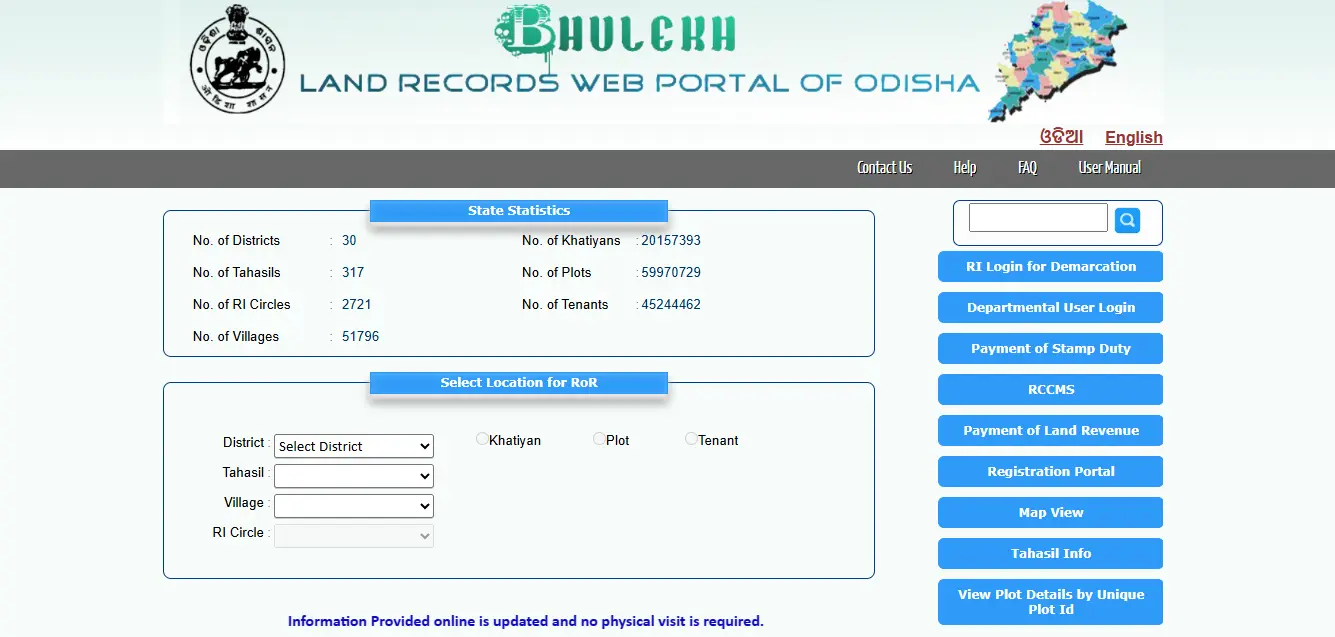
The scale of the Bhulekh ecosystem reflects the government’s commitment to state-wide transparency. The portal integrates data from 30 districts, providing a granular view of every registered land parcel.
State Administrative Statistics:
- Number of Districts: 30
- Number of Tahasils: 317
- Number of RI (Revenue Inspector) Circles: 2,721
- Number of Digitised Villages: 51,796
Land Data Statistics:
- Total Number of Khatiyans: 2,01,57,393
- Total Registered Plots: 5,99,70,729
- Total Registered Tenants: 4,52,44,462
- Monthly Traffic: 5+ Lakh visits
These figures demonstrate that Bhulekh Odisha is no longer just a database; it is a critical piece of public infrastructure processing over 4.5 lakh mutation cases annually and managing more than 1 lakh monthly land revenue transactions.
Key Services Available on the Portal
The Bhulekh portal is a multi-functional interface designed for diverse land-related tasks. [SEO Note: Insert keyword “Bhulekh Odisha” here] Below are the primary services available to users:
- Record of Rights (RoR): Provides textual data on ownership, land classification (Kissam), and historical remarks.
- Map View (Bhu Naksha): An interactive cadastral mapping solution based on high-accuracy GNSS technology.
- e-Pauti: A dedicated gateway for the online payment of land revenue (Khajana) and digital receipt generation.
- RCCMS (Revenue Court Case Monitoring System): A transparency tool allowing users to track pending land disputes and view cause lists.
- Tahasil Info: A directory providing administrative data and local contact information for all 317 Tahasils.
- Unique Plot ID: A tool to retrieve specific plot details Odisha using a systematic, encrypted identification code.
Step-by-Step Guide: How to Check RoR (Record of Rights) Online
The Record of Rights (RoR), commonly known as the Khatiyan or Patta, is the primary legal proof of land ownership in Odisha. It is prima facie evidence of possession and is required for property registration and bank loan approvals. You can access it via the official portal (bhulekh.ori.nic.in) through three distinct methods.
Method 1: By Khatiyan Number
- Visit the Bhulekh Odisha homepage.
- In the “Select Location for ROR” section, choose your District, Tahasil, Village, and RI Circle.
- Click the Khatiyan button.
- Select the unique Khatiyan number from the dropdown list.
- Expert Advice: Choose to view either the “ROR Front Page” (Ownership/Area) or the “ROR Back Page”. As a legal researcher, you must check the Back Page, as it contains critical “remarks” regarding bank encumbrances, pending court cases, or government restrictions.
- Click “View RoR” to display the document.
Method 2: By Plot Number
- Ensure your location details (District, Tahasil, Village) are correctly selected.
- Select the Plot radio button.
- Choose the specific Plot number from the available list.
- Click on “View RoR” to verify the specific survey data and land area.
Method 3: By Tenant Name
- Enter the location details as per the steps above.
- Select the Tenant option.
- Strategic Tip: When searching by name, be aware of phonetic misspellings in Odia-to-English transliteration. If the name does not appear, try searching for the first few letters or cross-reference with the Khatiyan number found on a physical tax receipt.
- Select the correct name from the list and click “View RoR”.
Unique Plot ID and Detailed Plot Search
A Unique Plot ID is a 16-digit (or village-specific) identification code assigned to every land parcel. It encapsulates the district, sub-district, village, and plot number. This ID is essential for institutional record-keeping and is used by banks to ensure they are financing the correct parcel.
To use this tool, select the “View Plot Details by Unique Plot Id” link on the homepage. If you do not have the ID, you can generate it by inputting the location data. This search bypasses the common errors associated with similar-sounding village names or re-numbered plots, providing a “clean” status report on the land’s current use and revenue standing.
Navigating Bhu Naksha: Viewing and Downloading Land Maps
Bhu Naksha Odisha is the spatial component of the land records system. Unlike traditional paper maps, these digital cadastral maps are integrated with the textual database and utilise GNSS (Global Navigation Satellite System) technology to provide 3-5 cm positional accuracy.
How to access land maps:
- Navigate to
bhunakshaodisha.nic.inor click “Map View” on the main Bhulekh portal. - Select the District and click Submit.
- Refine your search by selecting the Tahasil, RI Circle, Village, and Sheet Number.
- The interactive map will display. Clicking on a plot will fetch real-time data: owner’s name, plot boundaries, and a direct link to the RoR.
Downloading the Report: For planning and legal verification, click on the “Single Plot Report” or “All Plots Belonging to the Same Owner” options. This generates a PDF map that includes the plot dimensions and neighbouring survey numbers—a must-have for any architect or developer.
The 2026 Update: Smart RoRs and QR Code Verification
February 2026 saw the official launch of Smart RoRs, a revolutionary move by the Odisha government to eliminate “double-selling” scams and document forgery. This system moves away from vulnerable paper Pattas toward a tamper-proof digital standard.
Key Strategic Benefits:
- Instant QR Verification: Every new RoR document now includes a unique Smart ROR QR code. Buyers and bank managers can scan this code with a smartphone to fetch the real-time land history directly from the Bhulekh database, making forged paper documents obsolete.
- Blockchain-Style Security: The records are encrypted and integrated with the national DILRMP database. Any unauthorised attempt to alter digital data triggers an immediate “red flag” alert to the local Tehsildar and the state IT cell.
- Automatic Syncing: The system has bridged the gap between sale and record. Once a property is registered at the Sub-Registrar’s office, the data syncs almost instantly, ensuring the digital RoR reflects the change before the buyer even leaves the office.
Online Land Revenue Payment (e-Pauti)
The e-Pauti Odisha service allows landowners to settle their land revenue (Khajana) digitally. Maintaining updated tax records is essential, as a recent rent receipt is a mandatory document for obtaining home loans or applying for land conversion.
Step-by-Step Payment Guide:
- Visit
odishalandrevenue.nic.in. - Click on “PAY LAND REVENUE”.
- Input your District, Tahasil, and Village.
- Enter the Khatiyan number or Plot number.
- The system retrieves the Revenue amount due automatically.
- Enter the depositor’s details and proceed to the Odisha Treasury gateway.
- Support is available for UPI, Net Banking, and Credit Cards.
- Download Receipt: Always save the digital rent receipt. This document is a critical “proof of possession” in revenue court.
Mutation and Land Conversion: The 5T Initiative
Under the 5T Initiative (Transparency, Teamwork, Technology, Time, and Transformation), the mutation process has been modernised through “Auto-Mutation.”
The Auto-Mutation Workflow:
- Form-3 Transmission: This is the digital “bridge.” When a sale deed is registered, Form-3 is automatically transmitted from the Sub-Registrar to the Tahasil.
- Uncontested Cases: For standard sales with no disputes, the “Uncontested Disposal” timeline is strictly 7 working days. If this timeline is breached, the system sends a “red flag” to the Sub-Collector to investigate the delay.
- Contested Cases: If objections are filed, the timeline is capped at 30 working days.
Land Conversion: If you are purchasing agricultural land for residential use, you must apply for “Land Conversion” via the Tahasil. This reclassifies the land Kissam from “Agricultural” to “Homestead” (Gharabari), a prerequisite for building plan approval.
Buying Land in Odisha: The 2025 New Rules and SOPs
To protect small buyers from illegal layouts, the government introduced the “Part-Plot Registration SOP 2025.” As an expert, I advise all buyers to note that part-plot registration is now freely allowed except for Jalasaya (waterbody) plots, which remain strictly protected.
Key 2025 Provisions:
- Family Subdivisions: No town planning or BDA approval is required for inheritance or co-sharer cases.
- Small Plots (<500 sqm): Direct registration is permitted for personal residential use, bypassing the need for complex layout approvals.
- Agricultural Land: Buyers must provide a self-declaration that the land will continue to be used for farming unless a conversion fee is paid.
- Demarcation Requirement: All part-plots must have clear boundary demarcation and a confirmed access road before registration is approved.
Competitor Analysis: Official Bhulekh vs. Private Platforms
While Bhulekh Odisha is the only source of legally authoritative data, private platforms provide a “pre-verification layer” that can streamline your financial strategy.
- MagicBricks & Housing.com: These platforms use Bhulekh data to verify their “Certified” listings, giving buyers peace of mind during the discovery phase.
- Landeed: Offers a superior mobile user experience (UX) for those who need to pull records quickly on-site during property inspections.
- Bajaj Finserv: This is a strategic partner for the financing phase. By linking land verification to home loan eligibility, they offer a seamless transition. For buyers, the benchmarks are clear: interest rates starting at p.a.* and loan amounts up to ₹15 Crore*. Using these tools provides a strategic advantage in securing low-cost capital for high-value Odisha real estate.
Comparison Table: Land Record Platforms
| Platform Name | Core Strength | Authority Level | Strategic Value |
| Official Bhulekh | Legal Authority / Data Origin | Official | Authoritative Legal Proof |
| Bajaj Finserv | Loan Integration (7.15%*) | Informational | Financing & Eligibility |
| MagicBricks | Property Trust & Listings | Informational | Fraud-Risk Reduction |
| Landeed | Mobile UI Efficiency | Informational | On-site Field Verification |
| Housing.com | Buyer Journey Content | Informational | Educational “How-To” |
Essential Documents and Fees for Certified Records
While viewing is free, a certified copy of the RoR is necessary for sale deeds, mortgages, and court proceedings. To obtain one, you need your Identity Proof (Aadhaar), Title Deeds, and a recent Encumbrance Certificate (EC).
Application Fees Breakdown (Official):
| Service Component | Cost (in ₹) |
| User Cost & Government Fees | 30 |
| Printing Charges | 10 |
| Certificate Output Charges | 10 |
| Kiosk Operator Service Fee | 8 |
| Scanning Charges | 5 |
| DEGs (District e-Governance) | 2 |
Troubleshooting: Common Issues and How to Solve Them
- “No Record Found”: Often caused by village bifurcations. In Odisha, this is handled via Boundary Change Proceedings (BCP). During BCP, plots are re-numbered in a serpentine manner from the North-West to the South-East. If your plot “disappears,” check the “Old-New Correspondence List” at the Tahasil.
- Map Mismatches: If digital boundaries differ from physical possession, apply for a “Demarcation” case. A government Amin will conduct a physical survey to rectify the digital map.
- Browser Issues: The portal is designed for older architectures. If using modern browsers, you must use “IE Mode” in Microsoft Edge to render the RoR correctly.
- Payment Failures: e-Pauti often faces high traffic. Strategically, it is best to attempt payments during off-peak hours (after 9:00 PM).
Contact Information and Helplines
- Board of Revenue, Cuttack (Director, Land Records): 0671-2509582.
- Technical Support Email:
dilrmp.pmu@gmail.com. - Revenue Minister’s Toll-Free Helpline: 1800-121-8242 (10 AM – 5:30 PM).
- Tahasil Specific Info: Visit
dwistodisha.nic.infor local contact directories.
Frequently Asked Questions (FAQs)
1. What is a Khasra number in Odisha?
It is the unique survey or plot number assigned to a specific parcel of land for revenue identification.
2. Is basic RoR viewing free?
Yes, viewing for informational purposes is free. However, a certified copy for legal use attracts a fee of approximately ₹65.
3. What is the significance of “Kissam”?
Kissam denotes the land type (e.g., Sarada for agricultural, Gharabari for homestead). You cannot build on Sarada land without a conversion certificate.
4. How do I check for land disputes?
Use the RCCMS link on the portal to search by plot number or owner name for pending revenue court cases.
5. What is Jamabandi in Odisha?
Jamabandi refers to the land record register that tracks the entire ownership history and transaction sequence of a plot.
6. Can I use Bhulekh on a mobile?
Yes, though for the most accurate document rendering, a desktop browser in IE Mode is recommended.
7. How do I get a Land Use Certificate (LUC)?
This is obtained from the local Development Authority (e.g., BDA or CDA) and confirms the land’s zoning status.
8. What is the 5T timeline for mutation?
7 working days for uncontested cases and 30 working days for contested cases.
9. Why is a Unique Plot ID important?
It eliminates confusion between similar village names and ensures that banks and registrars identify the correct geometric parcel.
10. How often is the Bhu Naksha updated?
Maps are updated following setiap successful mutation or re-survey, often utilising drone-based data in 2026.
Conclusion: The Future of Land Governance
The Bhulekh Odisha ecosystem has fundamentally redefined the relationship between the citizen and the state. By dismantling the information monopoly of the past, the government has created a transparent, fraud-resistant framework that protects every landowner.
As the state moves toward “Conclusive Titling”—where the government provides a state-guaranteed title rather than just a presumptive record—the 2026 Smart ROR serves as the essential foundation. All landowners are strongly encouraged to regularly verify their Odisha land records online to ensure their investments remain secure in this digital era of governance.